
Tax Year vs Assessment Year: What the Income Tax Act 2025 Changed
• By Asksolique.ai Team • Income Tax Act 2025
Quick Answer
The Income Tax Act 2025 eliminates both "Previous Year" and "Assessment Year" and replaces them with a single unified concept: Tax Year. Effective April 01, 2026, income earned in Tax Year 2026-27 is assessed and filed for Tax Year 2026-27 — no more two-year lag, no more dual terminology. Section 3 of the new act defines the tax year as a 12-month period of the financial year commencing on April 01.
Why CAs and Tax Professionals Need to Understand This Change
If you have been practising tax law or handling compliance under the Income Tax Act, 1961, you have spent years keeping two calendars in your head:
- Previous Year — the year the income was earned
- Assessment Year — the year the same income was taxed and filed
For a CA explaining ITR filing to a first-time client, this two-year system was a recurring source of confusion. Why does income earned in FY 2024-25 get filed in AY 2025-26? Why are they separate at all?
The Income Tax Act, 2025 answers this question by removing the duality entirely.
This article covers exactly what changed, what stayed the same, how transitional cases are handled, and what it means for your practice from April 01, 2026 onwards.
What Was the Old System? (Income Tax Act, 1961)
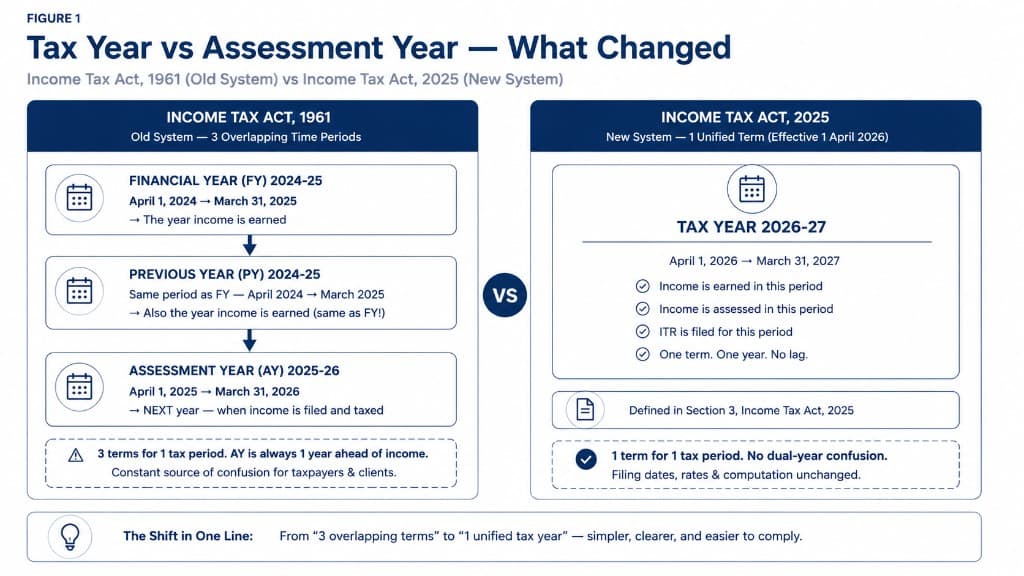
Under the Income Tax Act, 1961, every tax calculation involved three overlapping time periods:
| Term | Definition | Example |
|---|---|---|
| Financial Year (FY) | April 01 to March 31 – the year income is earned | FY 2024-25 i.e., April 2024 to March 2025 |
| Previous Year (PY) | Same as Financial Year – the year income is earned | PY 2024-25 i.e., April 2024 to March 2025 |
| Assessment Year (AY) | The year after the previous year – when income is assessed and filed | AY 2025-26 i.e., April 2025 to March 2026 |
The Confusion Built into This System
Income earned in FY 2024-25 (Previous Year 2024-25) was filed in AY 2025-26. That means every ITR form, every TDS certificate, every tax notice, and every court order had to specify two different years for the same income. A salary earner filing their return in July 2025 was filing for income earned the previous year under a year called "Assessment Year 2025-26" — terminology that bore no relation to when the income actually arrived.
For CAs managing large client bases across multiple compliance deadlines, this was not merely an inconvenience. It was a structural source of error.
What Changed Under Income Tax Act 2025
The Core Change: Section 3
Section 3 of the Income Tax Act, 2025 defines:
"Tax Year" means the twelve months period of the financial year commencing on the 1st day of April.
That is the entire definitional change. One section. One term. One time period.
The phrase "Previous Year" is replaced by "Tax Year" throughout the new Act. The phrase "Assessment Year" is discontinued entirely.
What This Means in Plain Terms
| Old (ITA 1961) | New (ITA 2025) |
|---|---|
| Financial Year / Previous Year | Tax Year |
| Assessment Year | Tax Year |
| Two years required to describe one tax period | One year describes everything |
| AY 2025-26 for income of FY 2024-25 | Tax Year 2024-25 for income of Tax Year 2024-25 |
The income you earn in Tax Year 2026-27 is assessed, filed, and referred to as Tax Year 2026-27. No lag. No dual nomenclature.
Effective Date: When Does This Apply?
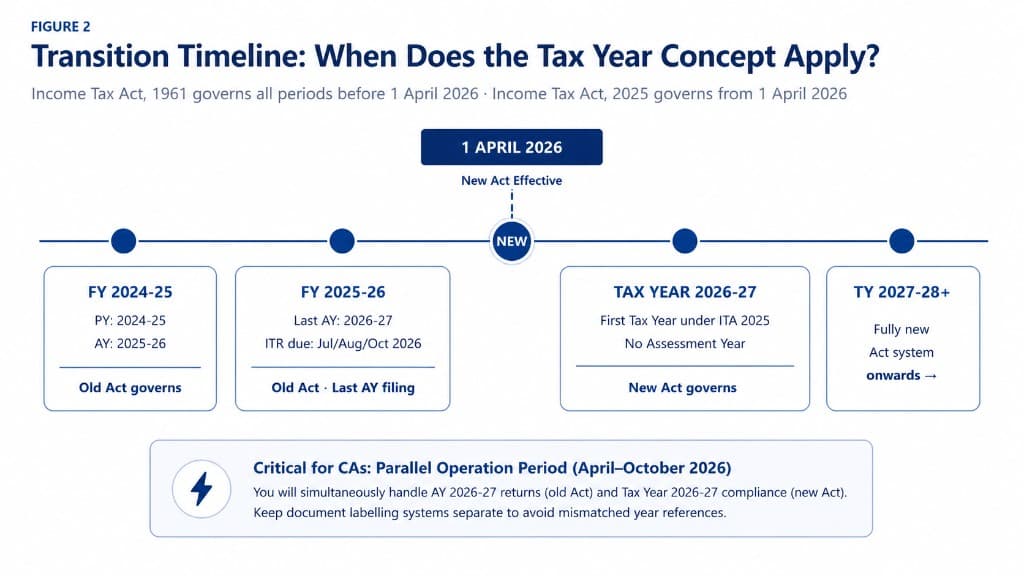
The Tax Year concept applies from April 01, 2026.
- Income earned from April 01, 2026 onwards is governed by the Income Tax Act, 2025, and is referred to as Tax Year 2026-27.
- Income earned up to March 31, 2026 remains under the Income Tax Act, 1961, with Assessment Year terminology intact.
- The ITR for FY 2025-26 is filed as AY 2026-27 under the old Act — Assessment Year terminology still applies to this return.
This is a critical distinction. The shift does not affect any pending or in-progress returns under the old Act.
The Transitional Mapping: How Old and New Years Correspond
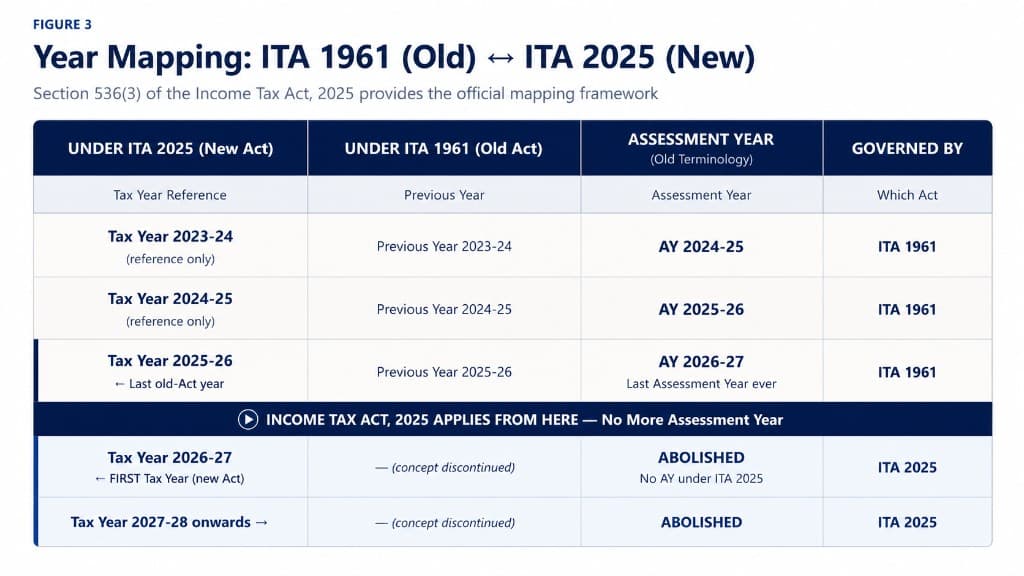
For cases that bridge both Acts — transitional provisions, pending assessments, ongoing appeals — the new Act provides a clear mapping framework under Section 536(3):
Any reference to "Tax Year" under the Income Tax Act, 2025 shall be read as a reference to the corresponding "Previous Year" under the Income Tax Act, 1961.
Year-by-Year Mapping Table
Practical takeaway for CAs: Any assessment, appeal, revision, or rectification pending as of March 31, 2026 continues to be processed under the Income Tax Act, 1961. The change in terminology does not reopen or affect those proceedings.
Does the Tax Year Change Filing Deadlines?
The regular due dates remain unchanged. However, the due date for filing a belated return has been revised. This is one of the most commonly asked questions by taxpayers and compliance teams. While the Act retains the existing statutory due dates for filing original returns, it introduces a change to the timeline for filing belated returns.
| Taxpayer Category | ITR Deadline |
|---|---|
| Salaried individuals and HUFs (no audit) | July 31 following the Tax Year |
| Business income – non-audit cases | August 31 following the Tax Year |
| Business income – audit cases (non-TP cases) | October 31 following the Tax Year |
| Business income – audit cases (TP cases) | November 30 following the Tax Year |
| Belated returns | March 31 following the Tax Year |
Special Cases: Newly Established Businesses
Under the old Act, businesses set up mid-year had a first "previous year" that was shorter than 12 months. The new Act handles this identically:
If a business is set up on December 01, 2026, its first Tax Year runs from December 01, 2026 to March 31, 2027.
The rule is preserved — only the label of Previous year and Assessment year has been changed.
What Does This Mean for CAs and Tax Professionals?
1. Client Communication Gets Simpler
Every tax communication from engagement letters to compliance trackers can now use a single year reference. "This is for Tax Year 2026-27" means both the income period and the filing period. Clients who have always been confused by FY vs AY terminology will find this significantly easier to follow.
2. Template and Software Updates Are Required
Any standard template, letter, or system that auto-populates "Assessment Year 20XX-XX" needs to be updated for Tax Year 2026-27 onwards. This includes:
- ITR form references.
- TDS certificates and challans.
- Tax audit reports.
- Demand notices and replies.
- Court filings referencing tax periods.
3. ICAI Exam Changes
The Institute of Chartered Accountants of India (ICAI) has confirmed that the Income Tax Act, 2025 will be implemented in CA examinations from May 2027 onwards. Students appearing in the November 2026 attempt will still be tested on the old Act.
4. Parallel Operation During Transition
For the filing season of AY 2026-27 (PY/FY 2025-26), CAs will simultaneously be handling:
- Returns for FY 2025-26 under the old Act (Assessment Year 2026-27).
- Compliance planning for Tax Year 2026-27 under the new Act.
This parallel period makes it critical to have a clear system for labelling and tracking which year's documents belong to which statutory framework.
Why the Income Tax Department Made This Change
The official rationale from the Income Tax Department's documentation:
"Use of the terms 'Previous Year' and 'Assessment Year' was causing confusion among taxpayers as they referred to two different financial years. This alignment of Tax Year with Previous Year/Financial Year eliminates the confusion caused by dual-year references under the Income Tax Act, 1961."
This change is part of a broader restructuring effort within the Income Tax Act, 2025 — reduces sections from 819 to 536, uses tabular formats for complex provisions, and eliminates archaic terminology throughout. The Tax Year change is the most visible simplification for everyday taxpayers.
No Impact on Accounting Year or Financial Statements
Since the Tax Year is aligned with the existing Financial Year (April 01 to March 31), businesses and entities do not need to change their accounting year, financial reporting cycles, or chart of accounts. The change is purely definitional and terminological — the fiscal calendar stays the same.
Frequently Asked Questions
Q: Is the assessment year completely abolished?
Yes. Effective April 01, 2026, the term "Assessment Year" is discontinued in the Income Tax Act, 2025. All references going forward use "Tax Year." However, for returns and assessments under the Income Tax Act, 1961 (i.e., for income up to March 31, 2026), Assessment Year terminology continues to apply.
Q: What is Tax Year 2026-27?
Tax Year 2026-27 refers to the 12-month period from April 01, 2026 to March 31, 2027. This is the first Tax Year governed by the Income Tax Act, 2025.
Q: How is Tax Year different from Financial Year?
Functionally, they are the same period — April 01 to March 31. The difference is that under the new Act, Tax Year serves the purpose of both the old Financial Year (income earning period) and the old Assessment Year (income assessment period), collapsing the two into one.
Q: What is the corresponding Assessment Year for Tax Year 2026-27?
Tax Year 2026-27 is the first year governed by the new Act and has no corresponding Assessment Year — that concept does not exist in the Income Tax Act, 2025.
Q: Does the change affect how TDS is deducted?
The deduction logic, rates, and thresholds for TDS are majorly unchanged by the Tax Year modification alone. However, the Income Tax Act, 2025 separately consolidates multiple TDS sections into three sections (Section 392, 393, and 394), which is a separate structural change covered under those provisions.
Q: Will ITR forms say "Tax Year" instead of "Assessment Year" from 2026-27?
Yes. All portal fields, forms, and certificates under the new Act will use Tax Year nomenclature for Tax Year 2026-27 onwards. For AY 2026-27 (the last assessment year return under the old Act), the old terminology continues.
Q: What does Section 536(3) of the Income Tax Act, 2025 do?
Section 536(3) provides the transitional mapping — any reference to "Tax Year" in the new Act corresponds to "Previous Year" under the old Act. This ensures continuity in pending assessments, litigation, and multi-year compliance cases.
How AskSolique.ai's Tax Twin Handles This
The transition from Assessment Year to Tax Year creates an immediate practical problem for compliance professionals: your reference material, case law, and CBDT circulars still use the old terminology. When a client asks about AY 2024-25 provisions and you search for Tax Year 2024-25 guidance, you need a system that bridges both.
Tax Twin, AskSolique.ai's AI-powered legislative intelligence feature, maps every provision of the Income Tax Act, 1961 against the Income Tax Act, 2025 — including how year references translate across both statutes. You can search using old terminology and see the corresponding new section, or search the new section and trace it back to the original provision with full legislative history.
Summary: What Changed, What Did Not
| What Changed | What Did Not Change |
|---|---|
| "Previous Year" → "Tax Year" | Filing due dates |
| "Assessment Year" discontinued | Tax rates and slabs |
| Two-year system → one-year system | Penalty structure |
| Section-level references updated | Accounting year of businesses |
| Portal nomenclature updated | Income computation method |
| Form labels updated | TDS deduction logic |
Disclaimer:
The information contained in this document is for information purposes only. In no way, this document should be treated as advice. Please reach out to us or your consultants for undertaking detailed analysis.
This author will not be liable for any loss or damage caused by the reader's reliance on information obtained through this report. The contents are provided for your reference only.
About Asksolique.ai
Asksolique.ai is a context-centric AI tool built for Indian tax professionals.Click hereto access.
Try it for free and see how much time you win back to focus on what truly matters.
Let's Have That Conversation
If the ideas in this article resonate with challenges your firm is navigating, we would welcome a conversation.
Frequently Asked Questions
Is the assessment year completely abolished?
Yes. Effective April 01, 2026, the term Assessment Year is discontinued in the Income Tax Act, 2025. All references going forward use Tax Year. However, for returns and assessments under the Income Tax Act, 1961 (i.e., for income up to March 31, 2026), Assessment Year terminology continues to apply.
What is Tax Year 2026-27?
Tax Year 2026-27 refers to the 12-month period from April 01, 2026 to March 31, 2027. This is the first Tax Year governed by the Income Tax Act, 2025.
How is Tax Year different from Financial Year?
Functionally, they are the same period — April 01 to March 31. The difference is that under the new Act, Tax Year serves the purpose of both the old Financial Year (income earning period) and the old Assessment Year (income assessment period), collapsing the two into one.
What is the corresponding Assessment Year for Tax Year 2026-27?
Tax Year 2026-27 is the first year governed by the new Act and has no corresponding Assessment Year — that concept does not exist in the Income Tax Act, 2025.
Does the change affect how TDS is deducted?
The deduction logic, rates, and thresholds for TDS are majorly unchanged by the Tax Year modification alone. However, the Income Tax Act, 2025 separately consolidates multiple TDS sections into three sections (Section 392, 393, and 394), which is a separate structural change covered under those provisions.
Will ITR forms say "Tax Year" instead of "Assessment Year" from 2026-27?
Yes. All portal fields, forms, and certificates under the new Act will use Tax Year nomenclature for Tax Year 2026-27 onwards. For AY 2026-27 (the last assessment year return under the old Act), the old terminology continues.
What does Section 536(3) of the Income Tax Act, 2025 do?
Section 536(3) provides the transitional mapping — any reference to "Tax Year" in the new Act corresponds to "Previous Year" under the old Act. This ensures continuity in pending assessments, litigation, and multi-year compliance cases.
Stay in the know with AskSolique.
Occasional insights on tax, regulation, and what’s new at AskSolique. Only when we have something worth sharing.