
The Firm Intelligence Layer: Why the Next Frontier of Tax AI Is Not Research
• By Asksolique.ai Team • Tax & Regulatory
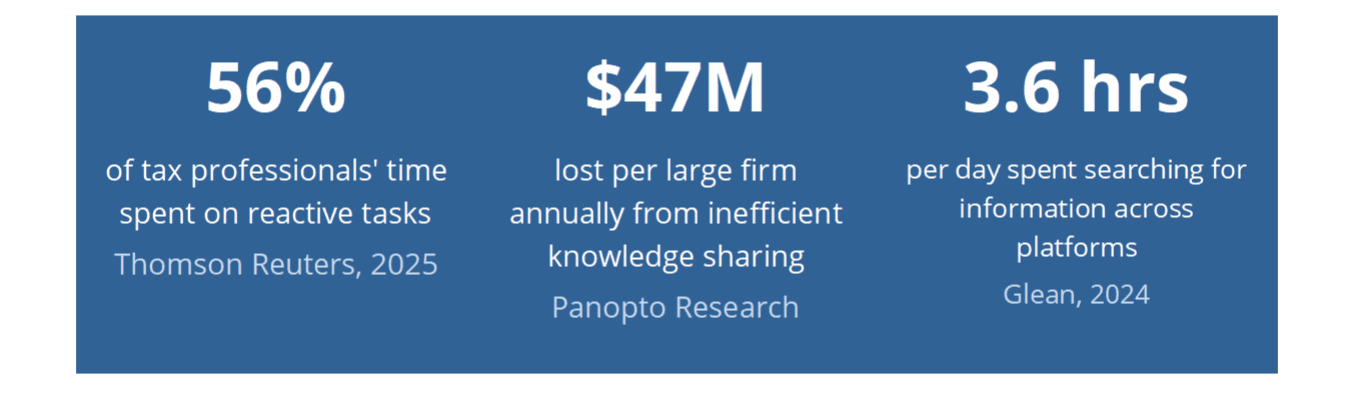
Tax professionals spend 56% of their time on reactive tasks. The answer is not faster research. It is smarter intelligence.
The global tax technology market will reach USD 60 billion by 2034. AI adoption among tax and accounting professionals leapt from 9% in 2024 to 41% in 2025. And yet, the core problem that costs professional firms tens of millions of dollars each year remains unsolved: institutional knowledge is trapped.
Tax professionals spend an average of 3.6 hours each day searching for information. They devote 56% of their total working time to reactive, administrative tasks, when their ambition is to allocate up to 70% to strategic advisory work. Large organisations lose an estimated USD 47 million annually through inefficient knowledge sharing alone. For the legal and tax sectors combined, the estimated annual productivity cost exceeds USD 32 billion.
The industry has invested heavily in technology. It has not yet invested in intelligence.
The Distinction That Matters
Access to information and the ability to act on it are not the same thing.
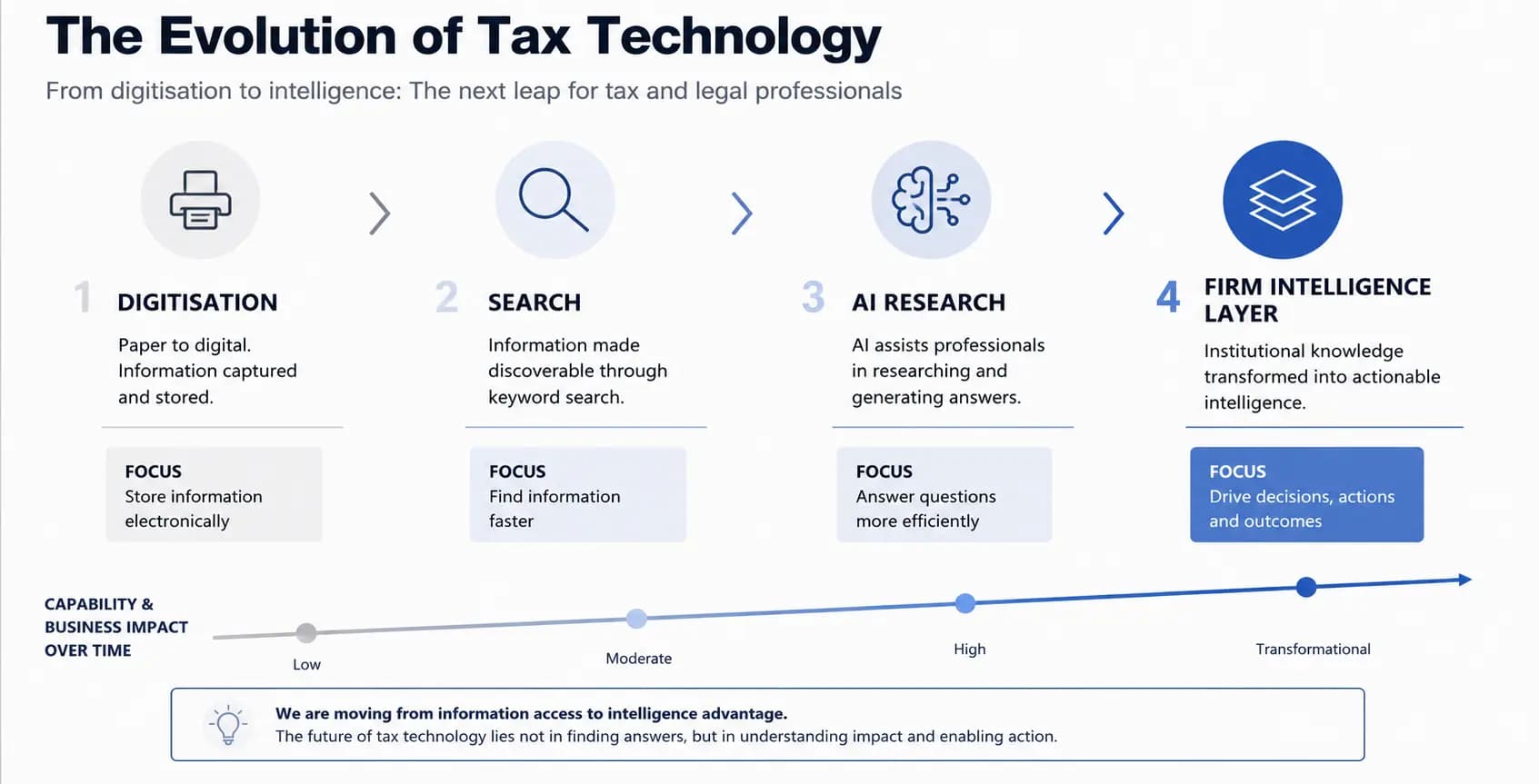
The first generation of tax technology digitised documents. The second generation made information searchable. The third generation introduced AI-assisted research, allowing professionals to ask questions in natural language and receive summarised answers drawn from large document sets.
Each generation delivered genuine value. Each also shared the same fundamental limitation: it assumed that access to information was the binding constraint. It is not.
The real constraint in professional firms is the gap between what the firm knows collectively and what any individual can find and apply at the moment it is needed. A partner may not know that a similar issue was analysed three years ago by a colleague in a different practice. A manager may spend hours researching a position that already exists somewhere in the firm's archive. An associate may be unaware that a circular issued last week directly affects six clients she is currently advising.
This is not a search problem. It is an intelligence problem.
What Firms Actually Have, and What They Lose
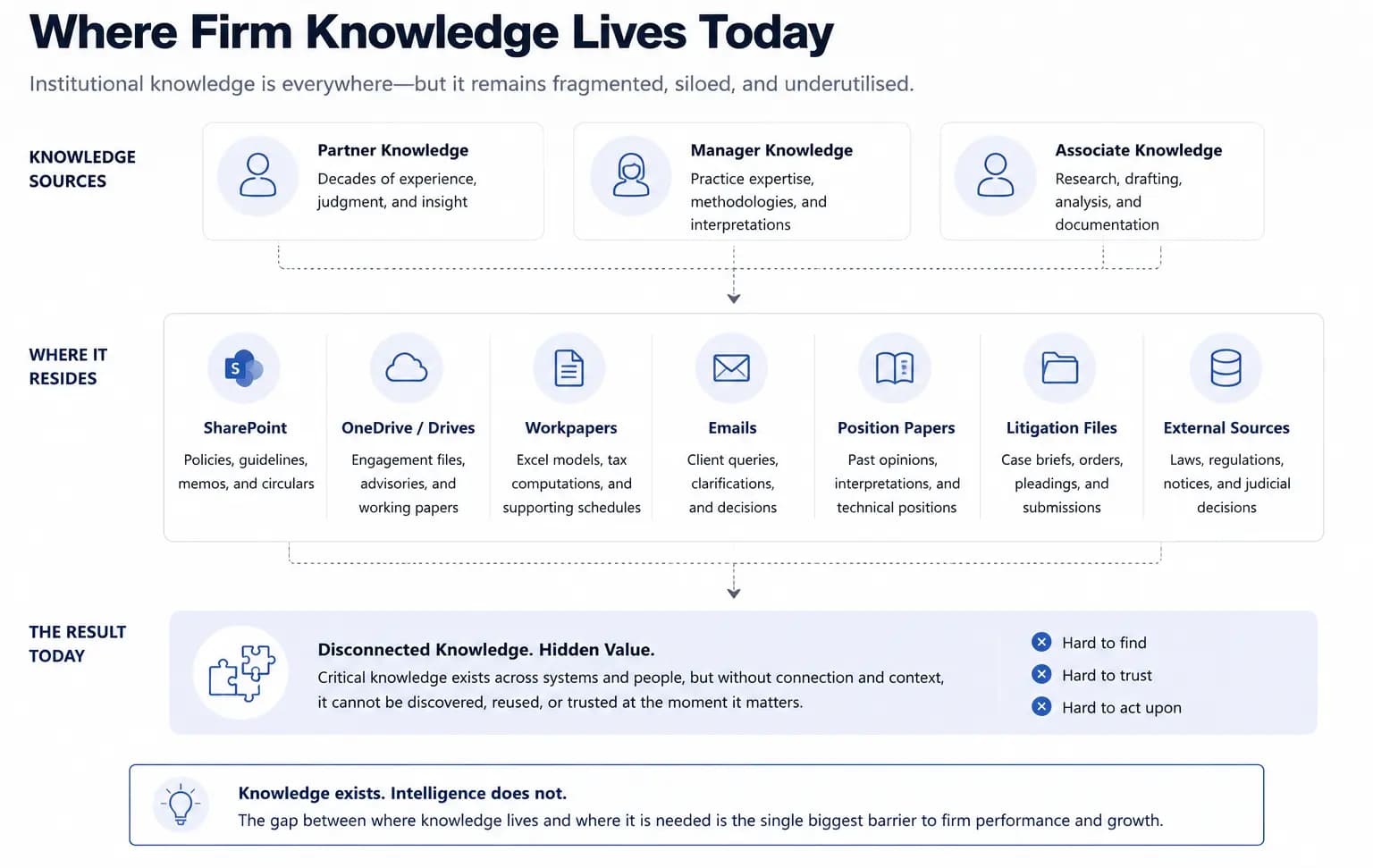
Professional firms are, in one sense, extraordinarily knowledge rich. Every opinion, advisory note, technical paper, tax position, client communication, and engagement file contributes to an expanding institutional memory. The problem is not the volume of knowledge. The problem is its fragmentation.
Research suggests that knowledge workers use only 38% of the knowledge available to them within their own organisations. 65% of employees possess expertise that their firms are either unaware of or fail to activate. U.S. large businesses collectively lose an estimated USD 47 million per year, per organisation, through inefficient knowledge sharing alone.
The challenge is not creating knowledge. The challenge is preserving, connecting, and operationalising it across the firm.
For tax and regulatory practices, the cost of this fragmentation is especially high. India alone operates one of the world's most structurally complex tax regimes, with overlapping frameworks across Income Tax, GST, SEBI, RBI, and MCA, each generating hundreds of notifications, circulars, and amendments each year. When a CBDT Circular is issued or a GST Council recommendation is enacted, the relevant question is not simply: what does this say? The question is: which of our clients are affected, which historical positions require review, and which engagement teams need to act?
Answering that question manually is time-consuming, inconsistent, and dependent on institutional memory that often resides in the minds of a handful of senior professionals.
Defining the Firm Intelligence Layer
A new category of technology is emerging to close this gap. We call it the Firm Intelligence Layer.
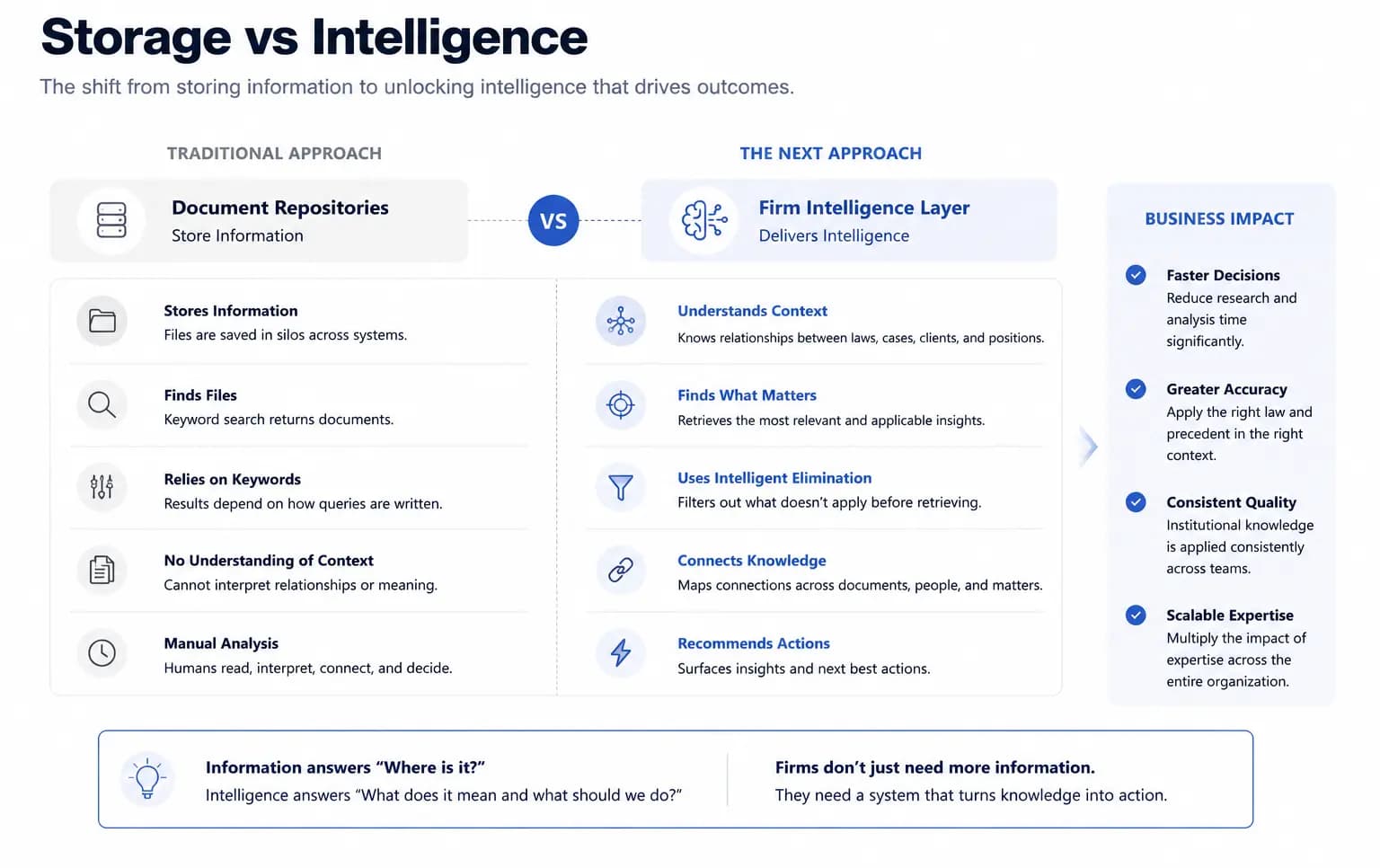
A Firm Intelligence Layer is not a document management system. It does not merely store information. It is not a research platform. It does not simply retrieve information. It is not an AI chatbot. It does not simply answer questions.
A Firm Intelligence Layer is an AI-powered system that sits above a firm's existing knowledge assets and transforms them into actionable intelligence. It understands context, relationships between clients and matters, regulatory impact, and recommended actions. It connects what the firm knows with what the firm needs to do.
The critical architectural distinction is where it lives. A Firm Intelligence Layer does not require firms to migrate their data, upload documents to an external server, or replace the systems already in use. It works on top of what already exists, whether that is Microsoft SharePoint, OneDrive, or any other repository the firm currently relies on. The firm's data remains within the firm's own environment. The intelligence layer is applied on top.
This matters enormously for professional firms, for whom data governance, client confidentiality, and jurisdictional privacy obligations are not optional considerations. The firm's institutional knowledge remains under the firm's control. What changes is the firm's ability to act on it.
Why Knowledge Graphs Change the Architecture
Traditional AI systems, including most current research and retrieval tools, treat information as disconnected text. They surface passages, rank results by similarity, and return content that matches the query. This serves a search use case adequately.
Professional advisory work does not operate that way.
A tax position is connected to a client. A client is connected to transactions. Transactions are connected to regulations. Regulations are connected to circulars, precedents, and judicial decisions. Prior positions create dependencies. New circulars create obligations to review existing advice. These are not just documents. They are a network of relationships.
Knowledge graphs provide a structured way to represent these relationships. Think of a knowledge graph as a map, not a filing cabinet. A filing cabinet stores information in folders. A map shows how every point connects to every other point and reveals paths that no individual search would surface.
Enterprise deployments demonstrate the impact. Law firms implementing knowledge graph-based AI have reported up to a 40% reduction in research time and 50% faster contract review.[8] LinkedIn reported a 77.6% improvement in AI retrieval accuracy after incorporating knowledge graph capabilities into its customer service systems.[11] In tax advisory, where applicability matters more than similarity, knowledge graphs are not optional sophistication. They are an architectural necessity.
What Intelligence in Practice Looks Like
Consider a concrete scenario.
A CBDT Circular is issued. A senior partner asks: does this affect any positions we have taken for a specific client?
Under a traditional workflow, answering this question may take hours. Someone must locate the relevant historical files, identify the applicable tax positions, cross-reference the new circular against those positions, form a view on whether action is required, and inform the relevant team members.
A Firm Intelligence Layer approaches the same question differently.
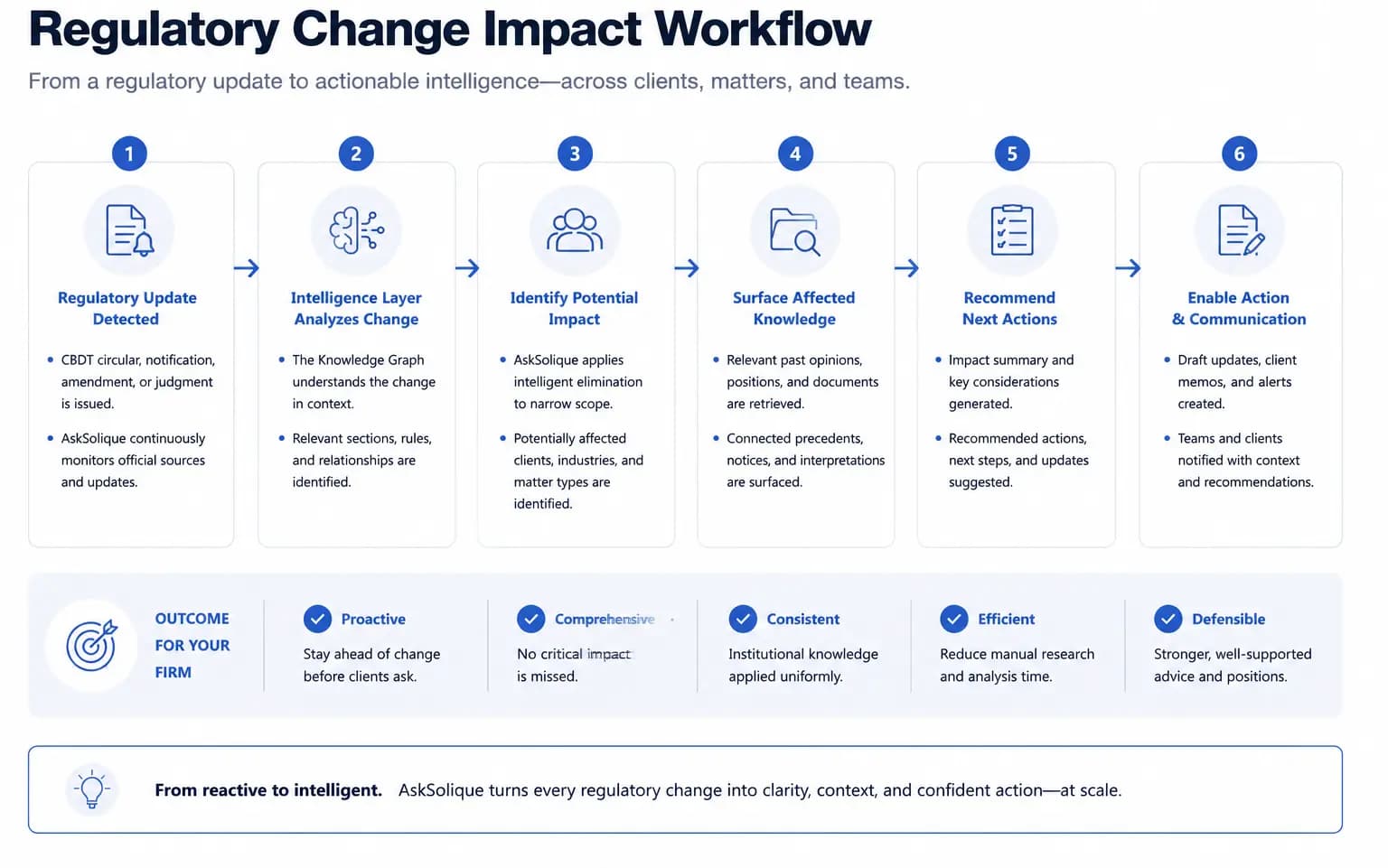
The professional is not searching for information. The professional is reviewing intelligence that is already contextualised, already connected to the right client and the right positions, and already actionable.
The time saved is significant. The consistency gained is more significant still. Every professional in the firm, at every level of seniority, has access to the same institutional intelligence. Not only those who happened to work on the original file, or who remember that a position was taken.
The Elimination Principle: Applicability Over Similarity
Most AI systems in professional services are built on retrieval logic: search everything, rank by relevance, and surface the top results. The professional then determines what is actually applicable.
A more effective architecture reverses this order.
Rather than beginning with retrieval and ending with a relevance judgement, an intelligence-first system begins by eliminating the irrelevant. What it surfaces is not the most similar content. It is the most applicable content.
This is the distinction between similarity and applicability. A system that finds documents most similar to a query serves a search use case. A system that identifies which provisions, positions, and precedents are applicable to a specific client in a specific situation at a specific moment serves an advisory use case.
For tax professionals, this is not an abstract distinction. It is the difference between a tool that produces more information and a tool that produces better answers.
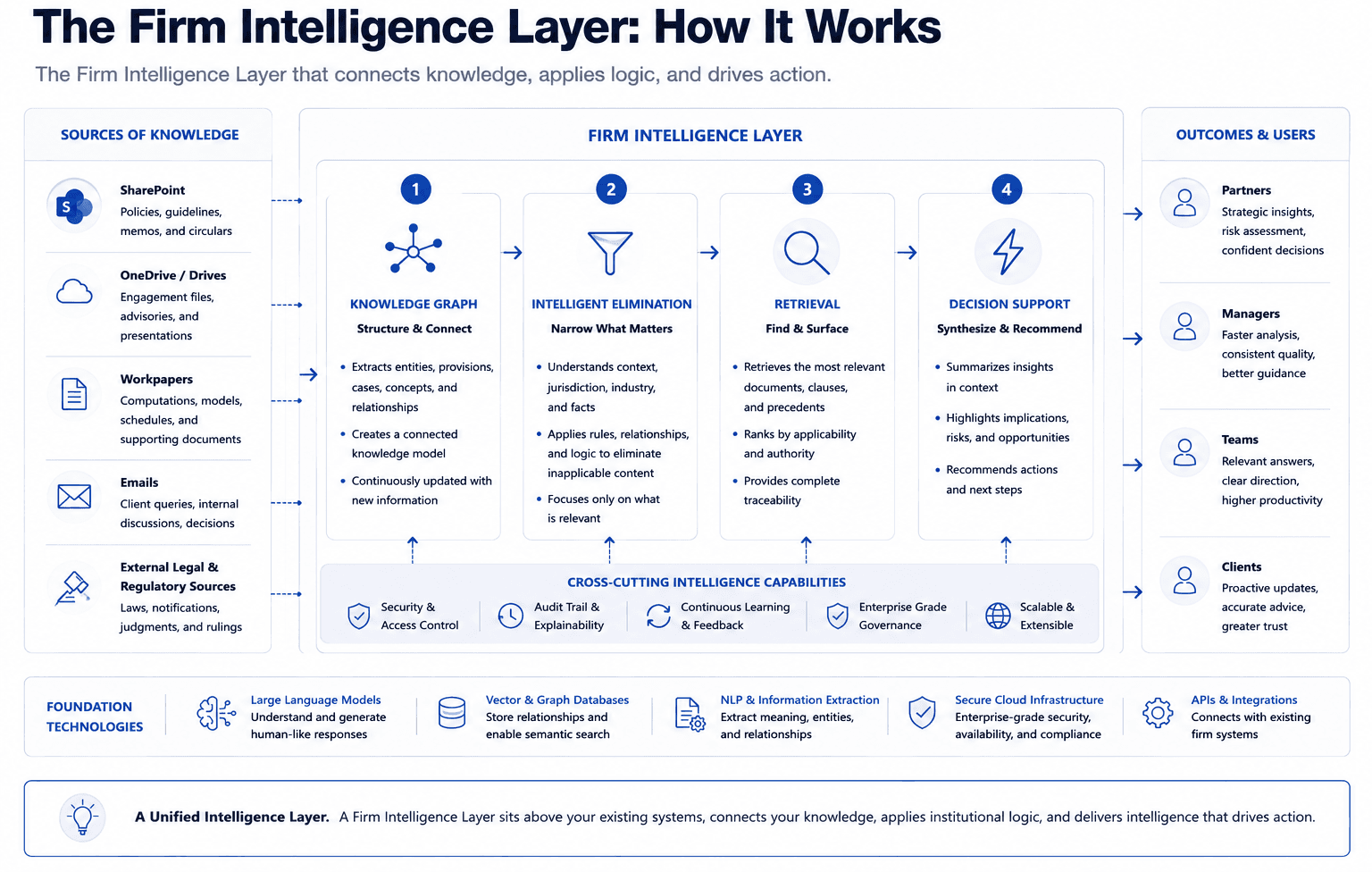
The Path Forward
The firms that will lead the next decade are not necessarily those with the largest repositories. They are those that can transform what they already know into what they can confidently do.
64% of finance leaders now rank AI and machine learning as a top investment priority, up from 43% just one year ago. AI adoption among tax and accounting professionals rose from single digits to over 40% within twelve months. Thomson Reuters projects that AI will save professionals up to 12 hours per week by 2029, equivalent to approximately 600 hours per professional annually.
But technology investment alone does not create intelligence. Systems that add retrieval capability on top of fragmented knowledge produce faster, more fragmented answers. The architectural question firms need to ask is not: can our AI find information faster? It is: can our AI transform what we already know into decisions we can confidently act on?
The Firm Intelligence Layer is the answer to that question. It is not the next version of tax research. It is a different category of technology, built for a different purpose: turning what firms know into what firms do.
Disclaimer:
The information contained in this document is for information purposes only. In no way, this document should be treated as advice. Please reach out to us or your consultants for undertaking detailed analysis.
This author will not be liable for any loss or damage caused by the reader's reliance on information obtained through this report. The contents are provided for your reference only.
About Asksolique.ai
Asksolique.ai is a context-centric AI tool built for Indian tax professionals.Click hereto access.
Try it for free and see how much time you win back to focus on what truly matters.
Let's Have That Conversation
If the ideas in this article resonate with challenges your firm is navigating, we would welcome a conversation.
Stay in the know with AskSolique.
Occasional insights on tax, regulation, and what’s new at AskSolique. Only when we have something worth sharing.