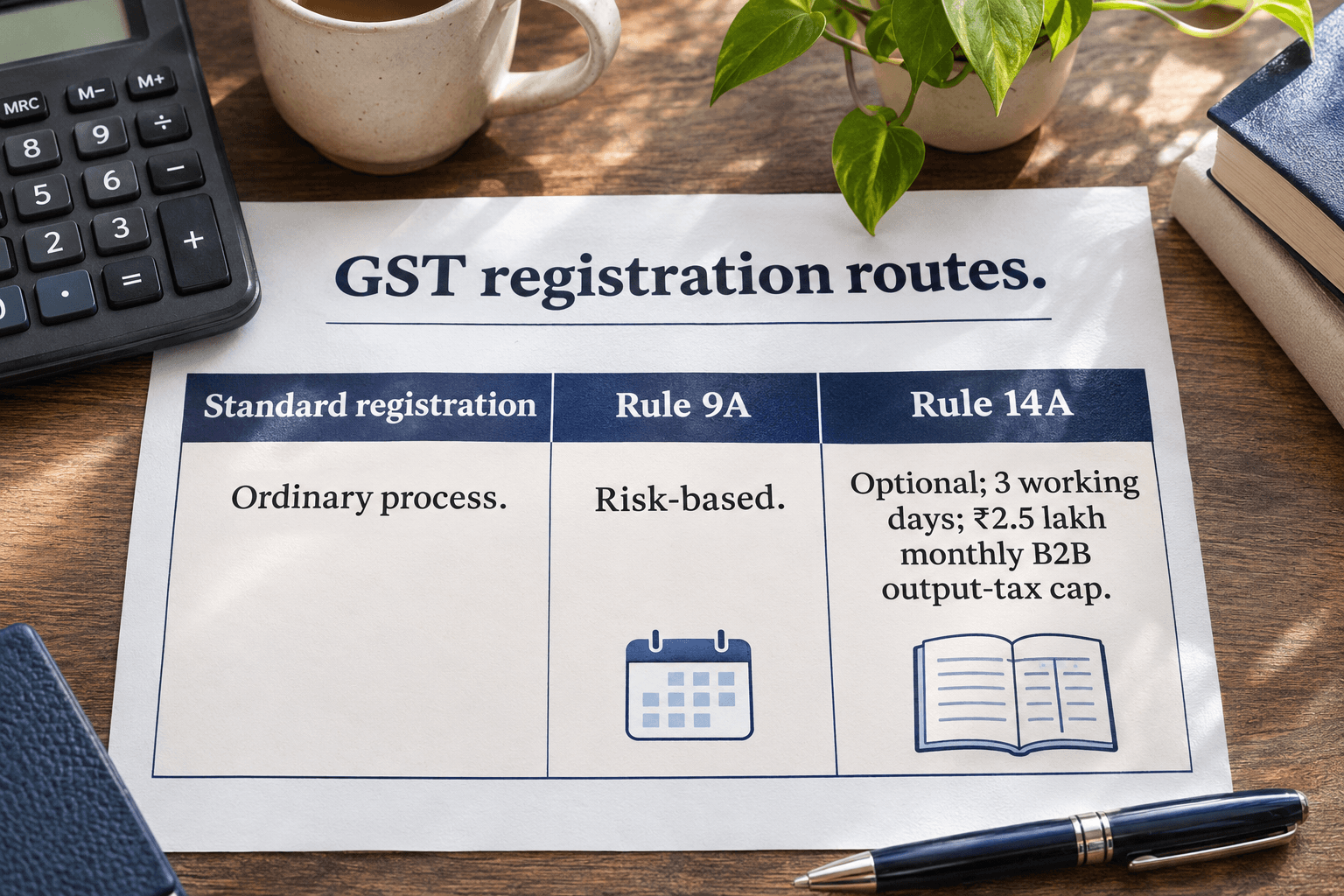
Cancellation of GST Registration: Voluntary Cancellation, Suo Motu Action and Revocation
Last updated:
Updated 13 November 2026. The law and GST portal guidance are stated as at this date.
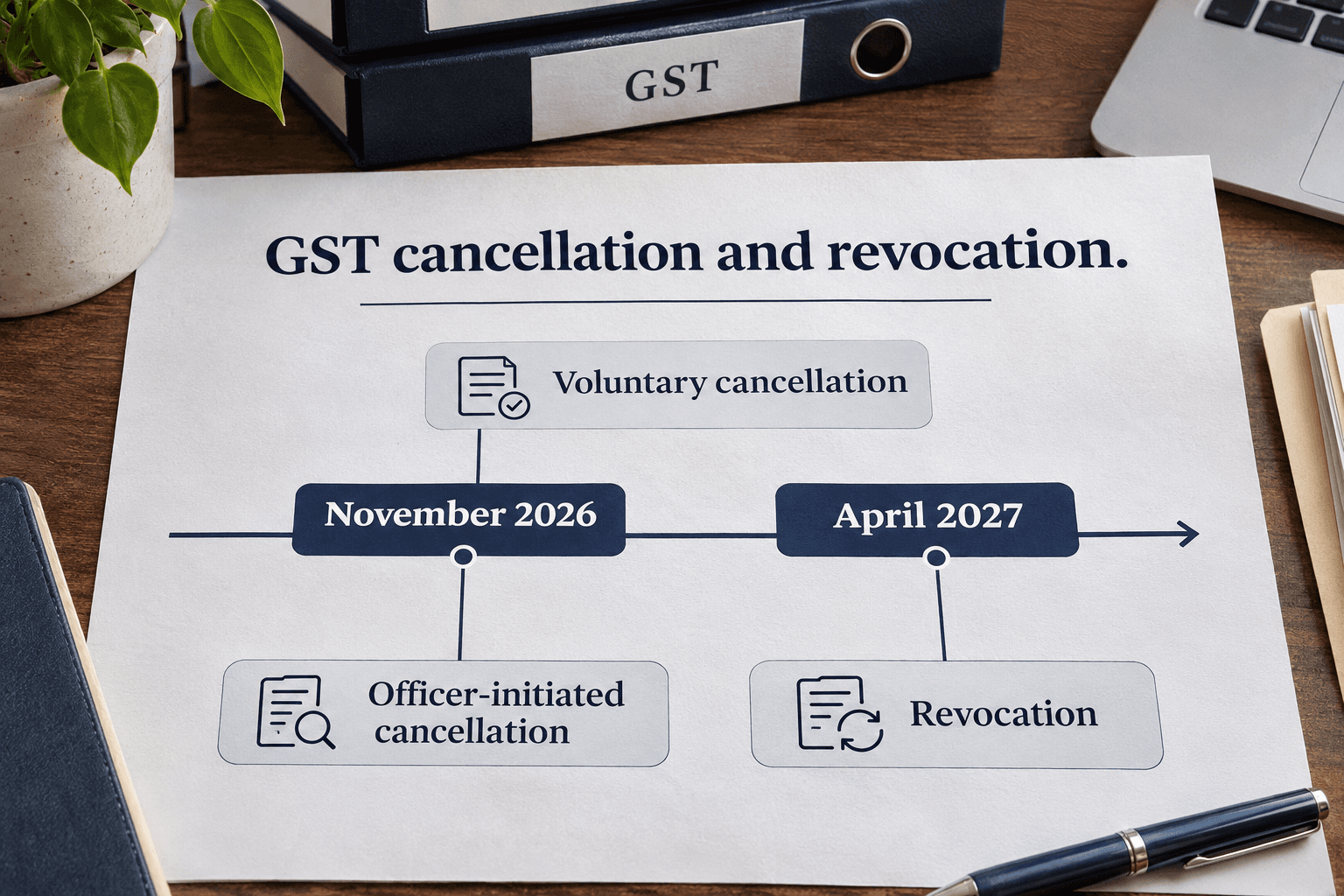
A business that has closed, been transferred or become ineligible for GST registration should bring its registration to an orderly end. At the same time, a taxpayer who receives a notice proposing cancellation needs to understand the grounds, response deadlines and available remedy. The Central Goods and Services Tax (Amendment) Rules, 2026 introduce a revised cancellation-on-request process from 1 November 2026 and a separate portal-based suspension and deemed-cancellation process from 1 April 2027. This article explains voluntary cancellation, officer-initiated cancellation, revocation and the liabilities that survive cancellation.
KEY TAKEAWAYS
- From 1 November 2026, a cancellation request in FORM GST REG-16 must be filed within 30 days of the event, and only after pending returns are filed. If the 30 days have passed, file anyway, without further delay.
- The portal cancels automatically where returns and dues are clear and either the ₹2.5 lakh monthly B2B test or the GSTR-10 timing test is met. Otherwise, the proper officer examines the request.
- The officer's show-cause route (REG-17, reply in REG-18, order in REG-19 or REG-20) continues both before and after 1 April 2027.
- From 1 April 2027, subject to the related amendments to the CGST Act, specified return and bank-account defaults are scheduled to lead to portal suspension and, if not cured within 30 days, deemed cancellation, with a 180-day portal revocation route.
- Cancellation does not end past liabilities: tax for earlier periods, the section 29(5) payment on stock and capital goods, and the GSTR-10 final return still apply.
The legal framework and the 2026 changes
Cancellation is governed principally by section 29 of the CGST Act, 2017; revocation of cancellation is dealt with in section 30. Rule 20 governs cancellation on the taxpayer's request, Rule 21 identifies prescribed grounds for cancellation, Rule 21A deals with suspension, Rule 22 sets out the officer's cancellation procedure, and Rule 23 deals with revocation of an officer-initiated cancellation. Notification No. 05/2026-Central Tax dated 26 October 2026 (G.S.R. 919(E)) amended these provisions in stages.
| Provision | Change | Effective date |
|---|---|---|
| Rule 20 | Substituted: new cancellation-on-request process, suspension on application, portal cancellation in qualifying cases and a procedure for changing the effective date of cancellation. | 1 November 2026 |
| Rule 21 | Substituted: five prescribed rule-based grounds for cancellation. Other grounds expressly contained in section 29(2) continue to apply. | 1 November 2026 |
| FORM GST REG-16 | Amended: revised entries, including stock and capital-goods details, and revised instructions for cancellation. | 1 December 2026 |
| Rules 21A and 22 | Substituted: officer suspension and show-cause procedure restated; new portal suspension for specified return and Rule 10A defaults, followed by deemed cancellation if not cured. | 1 April 2027 |
| Rule 23A | Inserted: a system-based revocation route for cancellations deemed by the portal under Rule 22(5). | 1 April 2027 |
The commencement dates matter. The revised Rule 20 and Rule 21 apply from 1 November 2026. The amended FORM GST REG-16 takes effect from 1 December 2026. The replacement Rules 21A and 22 and new Rule 23A do not take effect until 1 April 2027.
A caveat on April 2027. The April 2027 changes are linked to amendments to section 29 of the CGST Act, which require legislation and are expected to be in force by that date. Until those statutory amendments are enacted and brought into force, treat the April 2027 process as scheduled rather than settled, and check for further notifications before relying on it.
Voluntary cancellation under the substituted Rule 20
A registered person seeking cancellation under section 29(1) must apply in FORM GST REG-16 within 30 days of the event warranting cancellation. The application must state the inputs held in stock, inputs contained in semi-finished or finished goods, and capital goods held in stock, together with the related liability and payment details. The 30-day application period does not apply in the event of the death of a sole proprietor; the legal heirs may act in the proprietor's place.
Which form applies in November 2026. The substituted Rule 20 applies from 1 November 2026, but the revised FORM GST REG-16 applies only from 1 December 2026. An application filed in November 2026 is made in the REG-16 form then available on the portal, subject to the new Rule 20 conditions; the amended form revises the entries for stock, semi-finished and finished goods and capital goods, and the instructions.
If the 30-day period has passed. Rule 20 does not itself state the consequence of filing after 30 days. A business that has missed the window should still file REG-16 as soon as possible rather than wait. Until the registration is cancelled, returns continue to fall due and late fees continue to accrue, and a GSTIN left unattended is exposed to officer-initiated cancellation for non-filing. Keep a record of the date of the event and the reason for the delay.
The application cannot be filed until the prescribed return conditions are met. In particular:
- File returns due up to the proposed cancellation date. This includes applicable statements in FORM GST CMP-08 and returns for periods ending on or before the date from which cancellation is sought.
- Match GSTR-1 or IFF with GSTR-3B. If outward-supply details for a tax period have been furnished in FORM GSTR-1 or through the Invoice Furnishing Facility, the GSTR-3B for that tax period must also have been furnished before the cancellation application is submitted.
- Continue filing the remaining-period returns. After the application is submitted, returns for the remaining period up to the application date or the date from which cancellation is sought, as applicable, must be filed by their due dates.
- Pay amounts due. Tax, interest, fee, penalty and any other amount payable must be paid for the automatic cancellation route to apply.
On submission of the cancellation application, the registration stands suspended until the cancellation proceedings are completed. During this period, the taxpayer should not treat the GSTIN as an ordinary active registration. The remaining returns must still be filed by their due dates as required by Rule 20(3).
Example. A partnership firm closes its business on 10 December 2026. It must file FORM GST REG-16 by 9 January 2027, after furnishing all returns due for periods up to the date from which it seeks cancellation. If its returns were furnished on time, all dues are paid and its B2B output tax never exceeded ₹2.5 lakh in any month since registration, the portal can cancel the registration electronically. The firm must still file its final return in FORM GSTR-10 within three months of the cancellation.
When can the portal cancel the registration automatically?
Under Rule 20(5), the common portal cancels the registration electronically and communicates the cancellation in FORM GST REG-38 when the required returns have been furnished within time, all tax and other dues have been paid, and either of the following alternative conditions is met:
- B2B output-tax condition. The output tax liability declared in GSTR-1 (including GSTR-1A, where applicable) or through the Invoice Furnishing Facility on supplies to registered persons does not exceed ₹2.5 lakh in any month from the date of registration up to the cancellation application. This amount includes central tax, State or Union territory tax, integrated tax and compensation cess.
- Final-return condition. Where applicable, the registered person has filed FORM GSTR-10 within three days from the due date for furnishing the remaining-period returns referred to in Rule 20(3). This is not a three-day period counted from the due date of GSTR-10 itself. Although GSTR-10 is ordinarily filed after cancellation, this condition contemplates filing it while the application is pending and the registration is suspended.
Because the B2B test looks back to the date of registration, months before 1 February 2026 may include compensation cess. From that date compensation cess is no longer levied, so later months involve only central, State or Union territory and integrated tax. The ₹2.5 lakh figure mirrors the limit used for Rule 14A registration.
If the conditions for portal cancellation are not met, for example because a required return or payment remains outstanding, the application is forwarded to the proper officer for examination. If it is in order, the officer cancels the registration within 15 days of receiving it and issues FORM GST REG-19. If the application is deficient, the officer may issue FORM GST REG-03 within 15 days. The applicant must respond in FORM GST REG-04 within 15 days of receiving the notice. The officer then has 15 days from receipt of the reply to approve the application in REG-19 or reject it in REG-05. If no reply is filed within time, the application is deemed rejected and communicated in REG-05A. If the officer does not act within the prescribed 15-day period, the application is deemed approved and communicated in REG-19.
The revised Rule 20 also allows the proper officer, where there is reason to believe that the effective date of cancellation should be earlier, to issue a show-cause notice in FORM GST REG-34. The taxpayer replies in FORM GST REG-35 within 30 days. The officer either drops the proceedings in FORM GST REG-36 or changes the date in FORM GST REG-37; if no order is issued within 60 days of the notice, the proceedings are deemed dropped. Once changed, the effective date cannot be changed again. The procedure sits in the substituted Rule 20, in force from 1 November 2026, but forms REG-34 to REG-37 are inserted only with effect from 1 April 2027, so check whether the portal supports this route before then.
Suo motu cancellation: statutory grounds and Rule 21
Suo motu cancellation (often written "suo moto") means cancellation initiated by the proper officer on their own motion rather than at the taxpayer's request. Section 29(2) permits the proper officer to cancel registration, including from a retrospective date, on the statutory grounds set out in the Act. These include prescribed contraventions, specified return defaults, failure by a voluntary registrant to commence business within six months of registration, and registration obtained by fraud, wilful misstatement or suppression of facts. Rule 21, as substituted from 1 November 2026, specifies five rule-based grounds:
- Composition taxpayers. A person paying tax under section 10 has not furnished the return for a financial year for more than three months after its due date.
- Rule 23 compliance. The person has violated the third or fourth proviso to Rule 23(1).
- Monthly filers. A person required to furnish a return under section 39(1) for each month or part of a month has failed to furnish returns for six continuous months.
- Quarterly filers. A person required to furnish quarterly returns has failed to furnish returns for two continuous tax periods.
- Bank-account details. The person has violated Rule 10A, which requires furnishing bank-account details.
The five grounds describe the substituted Rule 21; they are not an exhaustive list of every circumstance in which section 29(2) permits cancellation. The Act's separate grounds relating to fraud, wilful misstatement or suppression and non-commencement of business after voluntary registration remain relevant. Note that grounds found in the earlier Rule 21, such as not conducting business from the declared place of business and issuing invoices without supply, are not among the five rule-based grounds in the substituted rule.
Officer-initiated cancellation: the show-cause route
Where the proper officer has reasons to believe that a registration is liable to be cancelled, the officer issues a show-cause notice in FORM GST REG-17, and the taxpayer must reply in FORM GST REG-18 within seven working days from service of the notice. Where the reply is satisfactory, the officer drops the proceedings in FORM GST REG-20. Where cancellation is warranted, the officer issues the cancellation order in FORM GST REG-19 within 30 days from the date of the reply, as prescribed by Rule 22. The taxpayer should respond with the facts, records and legal grounds relevant to each allegation rather than rely on a general denial.
This route does not end on 31 March 2027. The substituted Rule 22 that takes effect on 1 April 2027 keeps the same structure: notice in REG-17, a seven-working-day reply in REG-18, and an order in REG-20 or REG-19 within 30 days. What changes from that date is that specified return and Rule 10A defaults are also handled by the portal's suspension and deemed-cancellation route described in the next section.
Suspension while proceedings are pending. Cancellation is often preceded by suspension. Until 31 March 2027, the existing Rule 21A applies: the proper officer may suspend a registration while cancellation proceedings are pending, and the portal may suspend a registration where returns show significant differences or anomalies, or where Rule 10A bank-account details have not been furnished. Such a suspension is intimated in FORM GST REG-31, and the taxpayer is asked to respond or comply within 30 days. From 1 April 2027, the substituted Rule 21A(1) continues to allow the officer to suspend a registration on initiating cancellation proceedings, until those proceedings are completed. During any suspension, the taxpayer must not make taxable supplies or issue tax invoices, and should respond promptly, because an unanswered suspension is commonly followed by cancellation.
Portal suspension and deemed cancellation from 1 April 2027
From 1 April 2027, and subject to the caveat on the Act amendments above, substituted Rule 21A is scheduled to introduce electronic suspension for specified return defaults and Rule 10A non-compliance. The portal will intimate the taxpayer in FORM GST REG-31 and require the pending returns to be furnished or the bank-account details to be provided within 30 days. The specified defaults include:
- Composition return default. Failure to furnish the return for a financial year for more than three months after its due date.
- Monthly return default. Failure to furnish monthly returns for six continuous months.
- Quarterly return default. Failure to furnish returns for two continuous tax periods.
- Rule 10A default. Failure to comply with the requirement to furnish bank-account details.
If the taxpayer cures the default within the 30-day period, the suspension is deemed revoked. If the default is not cured, the registration is deemed cancelled electronically under Rule 22(5), and the portal communicates the cancellation in FORM GST REG-38. During suspension, the taxpayer must not make taxable supplies, issue tax invoices or charge tax, and is not required to furnish returns under section 39 for the suspension period. If the suspension is later revoked, the statutory provisions governing supplies made during suspension apply.
Revocation of cancellation
The route depends on how the registration was cancelled. An officer-initiated cancellation is dealt with under Rule 23. A cancellation deemed by the portal under the new Rule 22(5), effective from 1 April 2027, is dealt with under new Rule 23A.
| Issue | Rule 23: officer-initiated cancellation | Rule 23A: portal-deemed cancellation (from 1 April 2027) |
|---|---|---|
| Application form | FORM GST REG-21 | FORM GST REG-21 |
| Time limit | 90 days from service of the cancellation order. On sufficient cause and reasons recorded in writing, the Commissioner or an authorised officer not below Additional or Joint Commissioner may extend the period by up to 180 days. | 180 days from the date of cancellation. |
| Pre-conditions | Where cancellation is for non-filing, furnish the pending returns and pay tax, interest, penalty and late fee as required. | For return default, furnish pending returns and pay tax, interest, penalty and late fee. For Rule 10A default, furnish the required bank-account details. |
| Decision | The proper officer examines the application. If rejection is proposed, notice is issued in REG-23 and the reply is filed in REG-24; if revocation is allowed, the order is issued in REG-22. | On furnishing the pending returns or complying with Rule 10A, the application is deemed approved by the portal and an electronic order in REG-22 is communicated. |
| Returns after revocation | Returns due for the period from cancellation to revocation must be furnished within 30 days of the revocation order. | Returns due for the period from the cancellation order to the revocation order must be furnished within 30 days of the revocation order. |
For Rule 23, the 90-day period runs from service of the cancellation order. The extension is an additional period of up to 180 days; it is not automatic. The taxpayer must show sufficient cause, and the competent authority must record reasons in writing. Where the officer proposes to reject the revocation application, the taxpayer should respond to the notice in FORM GST REG-23 by filing FORM GST REG-24 within seven working days.
Rule 23A, effective 1 April 2027, is narrower. It applies only to registrations deemed cancelled electronically under Rule 22(5), that is, the portal cancellation route following failure to cure return or Rule 10A defaults. The taxpayer has 180 days from the date of cancellation to apply in REG-21. For a return default, the application cannot be filed until the pending returns are filed and the tax, interest, penalty and late fee payable on those returns are paid. For a Rule 10A default, the bank-account details must be furnished. Once the required compliance is made, the portal deems the application approved and issues REG-22 electronically.
What cancellation does not end
Cancellation does not extinguish liabilities for periods before the effective date of cancellation. Section 29(3) preserves the liability to pay tax and other dues and to discharge obligations under the Act and Rules for the pre-cancellation period, whether the amount is determined before or after cancellation.
Section 29(5) also requires payment of an amount relating to inputs held in stock, inputs contained in semi-finished or finished goods, and capital goods or plant and machinery on the day immediately preceding the date of cancellation. The amount is determined under the statutory method and Rule 44: it is the higher of the relevant input tax credit (after the prescribed reduction for capital goods) and the tax on the transaction value of the goods. The calculation should be prepared from stock records, purchase invoices and capital-asset records; it should not be treated as a generic reversal of every credit ever claimed.
A registered person required to furnish returns under section 39 whose registration is cancelled must furnish the final return in FORM GSTR-10 within three months from the date of cancellation or the date of the cancellation order, whichever is later. Late filing may attract late fee under section 47, subject to the applicable law and notifications.
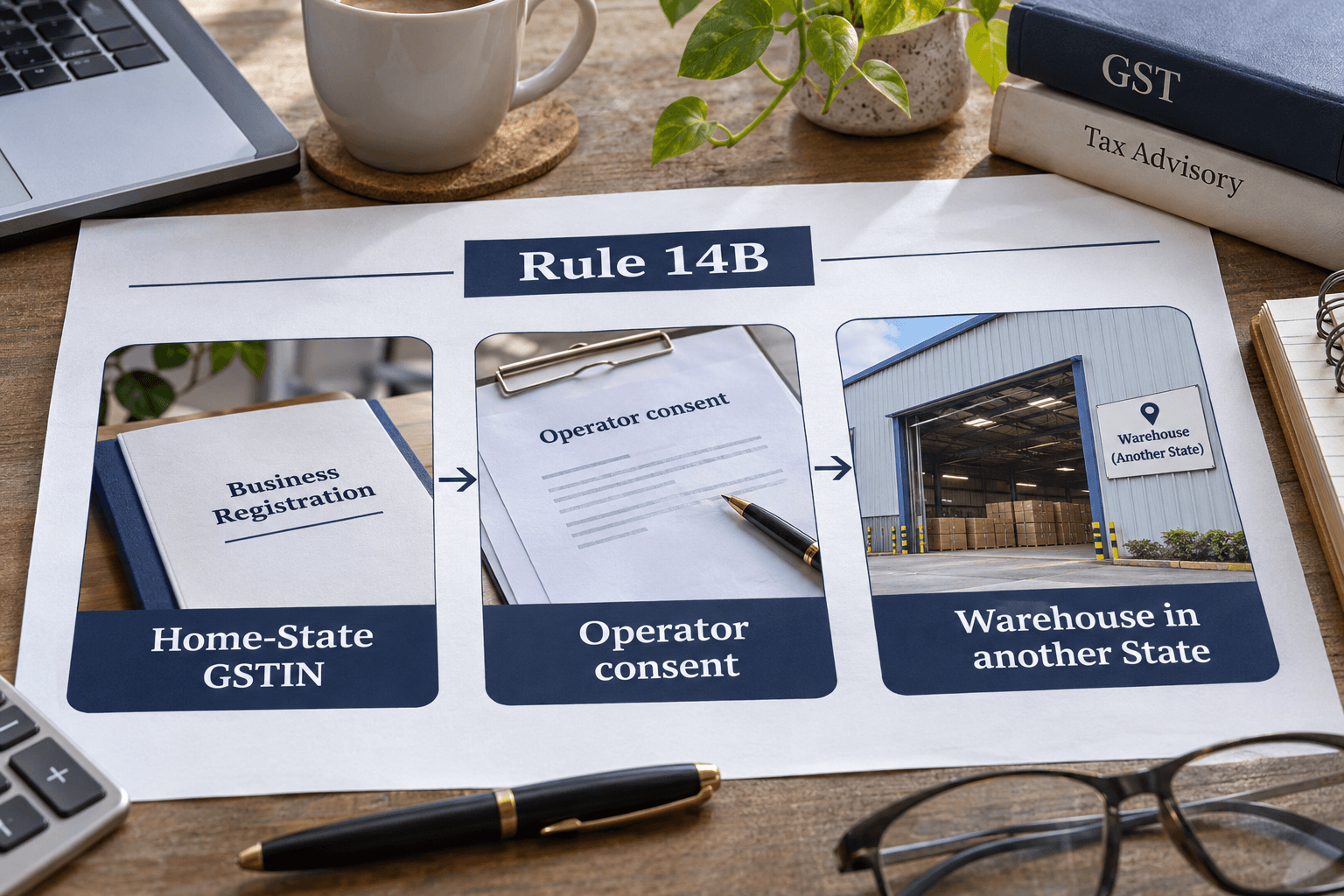
Sellers with Rule 14B registrations. If the cancelled GSTIN is a home-State registration used for Rule 14B registrations in other States, those linked registrations are deemed cancelled as well, with no separate cure period.
Does cancellation affect customers and input tax credit?
It can. An invoice issued for a period after the effective date of cancellation is not an invoice issued by a person holding an active GST registration for that period. A buyer's entitlement to input tax credit must be examined against all conditions in section 16 and the facts of the supply, payment and reporting. Where a supplier's registration is cancelled retrospectively, invoices falling after the effective date may be scrutinised. Buyers should verify GSTIN status and preserve evidence of the underlying supply, invoice, receipt of goods or services and payment.
Conclusion
A taxpayer seeking voluntary cancellation should first reconcile its returns, payments, stock and capital goods, and then file FORM GST REG-16 within 30 days of the event. The automatic portal route is available only where the prescribed return, payment and threshold or final-return conditions are met; otherwise, the proper officer examines the application.
For officer-initiated cancellation, the taxpayer should identify the statutory ground, respond within the notice period and keep evidence of compliance. That show-cause route continues after April 2027, when specified return and Rule 10A defaults will also move to an electronic suspension and deemed-cancellation route with a separate 180-day portal revocation process. Cancellation should therefore be treated as a compliance event, not merely as closing a GSTIN.
RESEARCH WITH ASKSOLIQUE
Cancellation and revocation now run on two timelines, with different forms and deadlines before and after 1 April 2027. AskSolique.ai brings the CGST Act, Rules, notifications and circulars into one research workspace, so you can confirm which version of a rule applies on a given date before you respond to a notice.
This article is for general information and reflects the law and GST portal guidance as at 13 November 2026. It is not legal or tax advice. Check the current rule text and portal advisories, and the facts of your case, before acting.
Frequently Asked Questions
Can I cancel GST registration if returns are pending?
Not through the taxpayer-initiated route under the substituted Rule 20. Before FORM GST REG-16 is submitted, the returns and applicable CMP-08 statements due for periods ending on or before the proposed cancellation date must be furnished. If GSTR-1 or IFF has been filed for a tax period, GSTR-3B for that period must also be filed. Returns for the remaining period after application must then be furnished by their due dates.
What is suo moto cancellation of GST registration?
It is cancellation initiated by the proper officer on their own motion (correctly written "suo motu"), rather than on the taxpayer's application. The officer issues a show-cause notice in FORM GST REG-17, the taxpayer replies in REG-18 within seven working days, and the officer either drops the proceedings in REG-20 or cancels the registration in REG-19.
What can I do if the revocation deadline has passed?
First confirm whether the 90-day Rule 23 period and any permissible extension have actually expired, or whether the 180-day Rule 23A route applies to a portal-deemed cancellation from 1 April 2027. If the applicable revocation period has expired, consider whether an appeal against the cancellation order is available under section 107. The ordinary appeal period is three months from communication of the order, with a possible further one-month condonation period on sufficient cause. The facts and limitation position should be reviewed promptly.
Is there a fee or penalty for surrendering GST registration?
There is no separate government application fee for filing a cancellation request. Amounts that may still need to be paid include tax, interest, late fee, penalty and the amount payable on stock and capital goods under section 29(5). A delayed final return in FORM GSTR-10 may attract late fee under section 47, subject to applicable caps, waivers and notifications.
Does GST liability end on the date of cancellation?
No. Section 29(3) preserves tax, interest, penalty and other obligations relating to periods before cancellation. The taxpayer may also have to pay the amount calculated under section 29(5) for inputs, semi-finished or finished goods and capital goods, and file the final return in FORM GSTR-10 where applicable.
Stay in the know with AskSolique.
Occasional insights on tax, regulation, and what’s new at AskSolique. Only when we have something worth sharing.