Rule 14B GST Registration: How E-commerce Sellers Can Register in Another State Without an Office
Last updated:
Updated 13 November 2026. The law and GST portal guidance are stated as at this date.
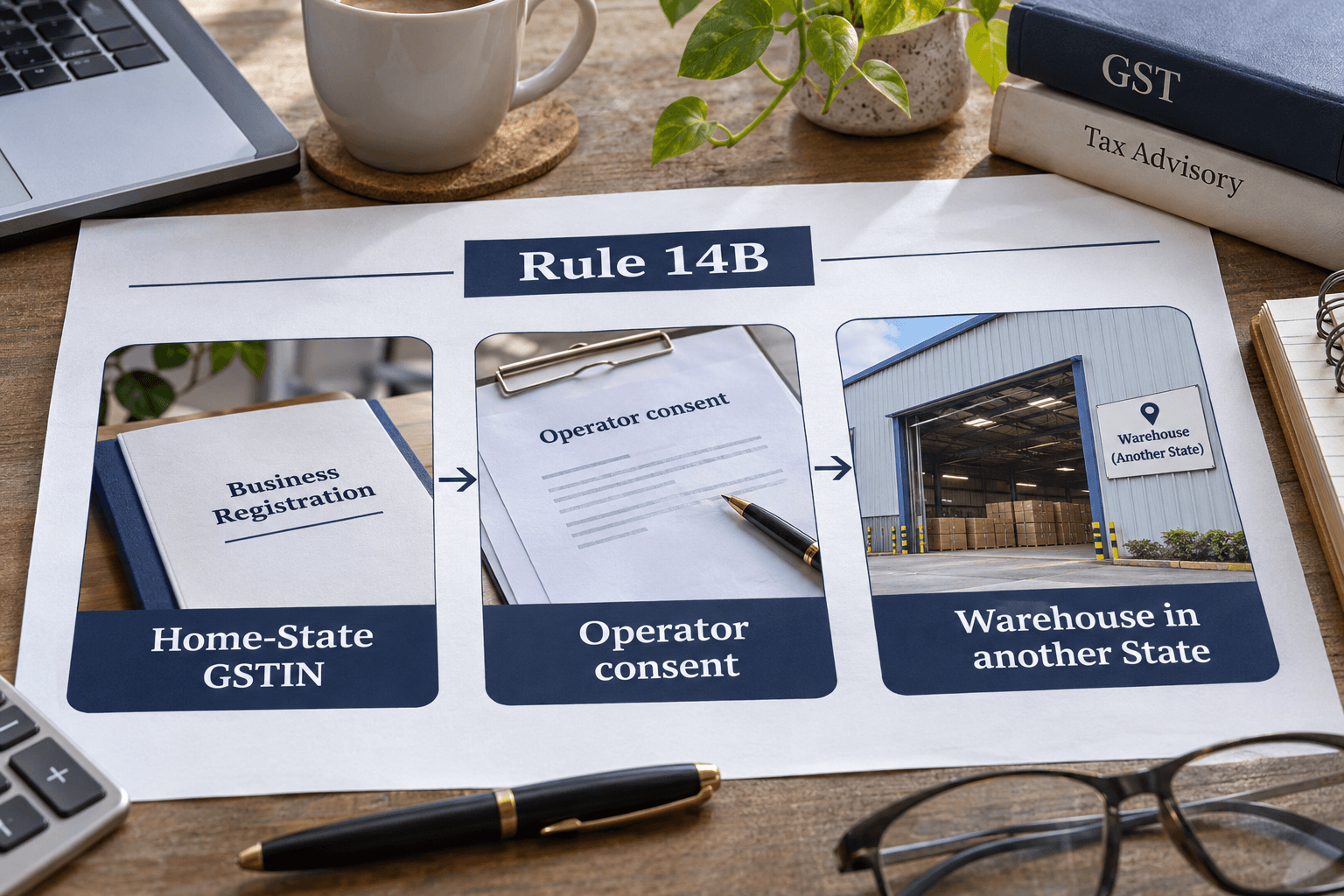
A seller registered in one State may want an e-commerce operator to store its goods in a warehouse in another State. Until recently, the seller would generally need to establish a principal place of business in that second State to obtain a separate GST registration. Rule 14B creates a limited route for eligible goods suppliers to use an approved e-commerce operator warehouse as the principal place of business, even where the seller has no physical presence in that State. The option has strict eligibility conditions and depends on the seller's home-State GSTIN and the operator's consent.
KEY TAKEAWAYS
- Rule 14B, in force from 1 November 2026, lets an eligible goods seller register in another State by declaring an e-commerce operator's warehouse as its principal place of business.
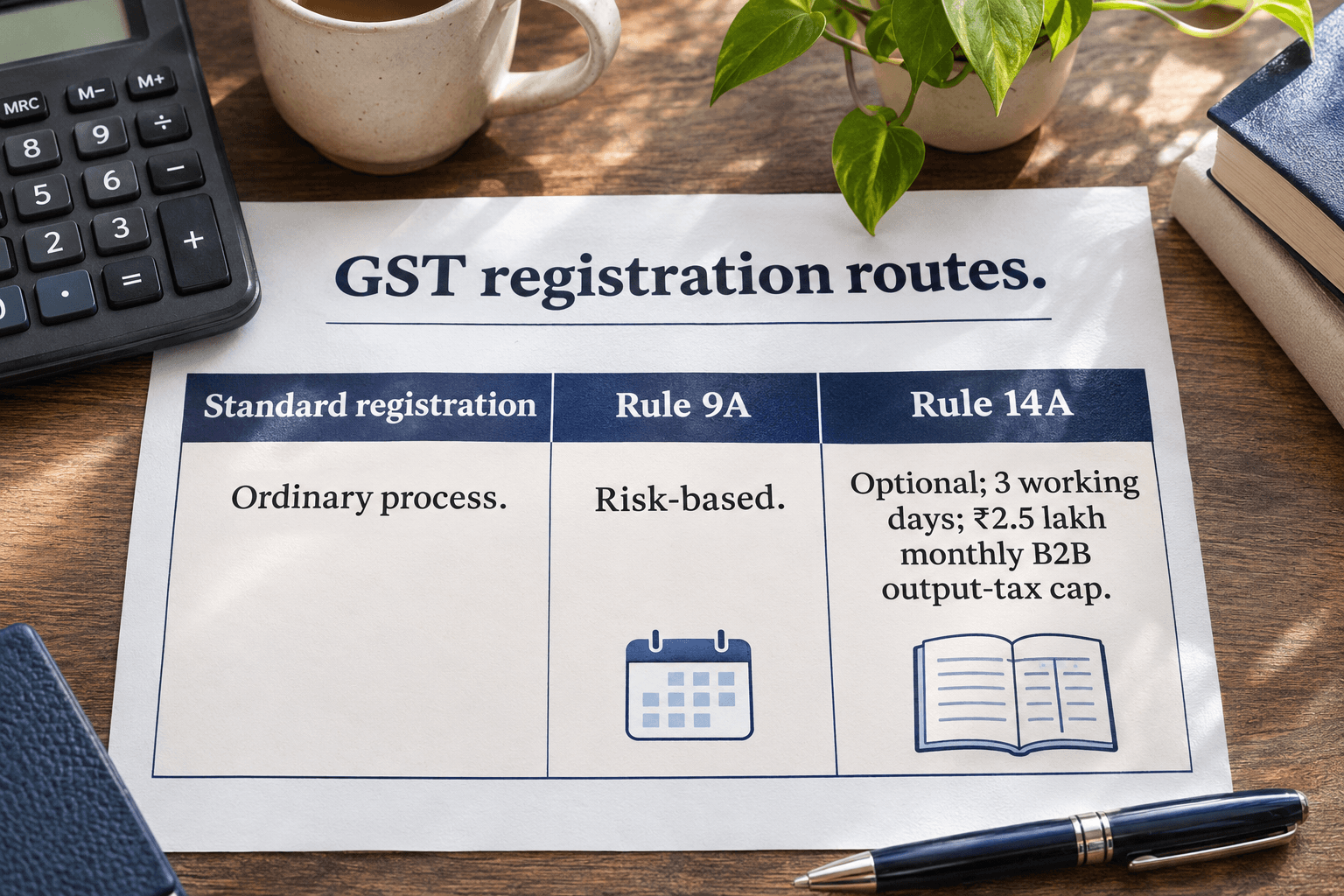
- The seller needs an active home-State GSTIN under the same PAN, registered under Rule 9. The GSTN advisory also excludes GSTINs registered under Rule 14A or Rule 9A.
- Output tax on supplies to registered buyers must stay within ₹2.5 lakh a month. Sales to unregistered consumers are not counted.
- The operator must consent within seven working days, and the registration may be used only for supplies made through e-commerce operators.
- The registration depends on the home-State GSTIN and the operator's permission. If the home-State GSTIN is cancelled, the Rule 14B registration is deemed cancelled with no cure period; if the operator withdraws permission, the seller has 30 days to amend.
What Rule 14B allows
Rule 14B was inserted into the CGST Rules, 2017 by Notification No. 05/2026-Central Tax dated 26 October 2026 (G.S.R. 919(E)), following the recommendation of the 57th GST Council meeting held on 8 October 2026. It came into force on 1 November 2026. It allows a person with an eligible GST registration in one State or Union territory to obtain another registration under the same PAN in a different State or Union territory where the person has no physical presence, by declaring an e-commerce operator's warehouse as the principal place of business.
The GSTIN in the State where the seller has a physical business presence is referred to in the rule and GSTN guidance as the home-State GSTIN. The seller may also declare other warehouses of the same or another eligible e-commerce operator in the destination State as additional places of business. The GST registration certificate records the warehouse address and the home-State principal place of business.
Who qualifies
The statutory conditions in Rule 14B must be read together with the GSTN advisory on the portal workflow issued on 1 November 2026. In practice, the applicant should check each of the following before selecting the Rule 14B option:
- Eligible home-State registration. The applicant must have at least one active regular GST registration under the same PAN in another State or Union territory where it has a physical presence.
- No registration or physical presence in the destination State. The applicant must have neither a physical presence nor an active regular registration in the State or Union territory where it seeks the Rule 14B registration.
- Eligible destination jurisdiction. The GSTN advisory excludes jurisdictions falling under the "Other Territory" category.
- Eligible taxpayer category. The portal scheme is for regular taxpayers using FORM GST REG-01; it excludes composition taxpayers, input service distributors, SEZ developers, SEZ units and casual taxable persons.
- No disqualifying home-State status. The home-State GSTIN must be active and regular, must not be registered under Rule 14A or Rule 9A, and must not fall under State Code 97 ("Other Territory"). A Rule 14A registrant can withdraw from that option first; see the withdrawal section below.
- No pending cancellation trigger in the home State. The GSTN advisory states that the application is permitted only where no proceedings under section 29 have been initiated and no cancellation application has been filed for the home-State registration.
- Goods supplied through an eligible operator. The applicant must intend to supply goods through an e-commerce operator required to collect tax at source under section 52 of the CGST Act.
- Monthly B2B output-tax threshold. The total output tax liability on the relevant supplies to registered persons must not exceed ₹2.5 lakh per month. Supplies to a person registered under the same PAN are excluded from this calculation.
- Operator consent. The e-commerce operator must consent to the use of its warehouse as the principal place of business. The relevant operator GSTIN must be active in the destination State and have an active TCS registration under the same PAN in that State.
A person who has not opted for Aadhaar authentication is not eligible unless the person is notified under section 25(6D). The scheme permits only one Rule 14B registration per PAN in each State or Union territory. It can therefore support registrations in more than one destination State, but not multiple Rule 14B registrations for the same PAN within the same State or Union territory.
The Rule 9A exclusion needs particular attention. Rule 14B(1) itself refers to a person registered under Rule 9, the standard route, and the GSTN advisory expressly excludes home-State GSTINs granted under Rule 9A. Rule 9A is the risk-based route under which the portal itself identifies an application and grants registration within three working days; the applicant does not choose it, and unlike Rule 14A there is no form to withdraw from it. A seller that obtained its home-State GSTIN within a few days without electing Rule 14A may have been registered under Rule 9A, and this is not always obvious from the registration certificate. Before applying, confirm the route through a GSTN helpdesk ticket and keep the response on file, because neither the rule nor the advisory sets out a path for such sellers.
Reading the ₹2.5 lakh limit correctly
The limit measures output tax, not turnover. It applies to supplies to registered persons and aggregates the central tax, State tax or Union territory tax and integrated tax specified in Rule 14B. Tax attributable to supplies to another registration held under the same PAN is excluded. Sales to unregistered consumers do not enter this particular B2B calculation.
Unlike the Rule 14A limit, whose text also lists compensation cess, the Rule 14B test does not include cess. Sellers moving between the two routes should not assume the calculations are identical.
For a simple illustration, if all relevant supplies to registered buyers attract GST at 18%, ₹2.5 lakh of tax corresponds to taxable value of approximately ₹13.89 lakh in a month. A seller with supplies at multiple rates should calculate the tax on each relevant supply and aggregate the amounts.
Example. A seller based in Karnataka expects to sell ₹10 lakh a month through a marketplace warehouse in Maharashtra. Of this, ₹6 lakh is to GST-registered buyers at 18% and ₹1 lakh to registered buyers at 5%; the rest is to consumers. Its B2B output tax is ₹1.08 lakh plus ₹0.05 lakh, or ₹1.13 lakh, which is within the limit. A seller that expects its monthly B2B tax to exceed the threshold should consider ordinary registration based on an appropriate place of business rather than assume Rule 14B will continue to be available.
If the limit is crossed. Rule 14B does not say what happens if actual B2B output tax in a month goes above ₹2.5 lakh. The threshold is an eligibility condition, not a cap on what may be reported: every supply must still be reported and tax paid on its actual value. A seller that crosses it should take advice promptly, because its continued eligibility for the Rule 14B registration may be questioned.
How the application moves through the GST portal
The GSTN advisory dated 1 November 2026 describes the operational steps. The key stages are:
- Start FORM GST REG-01. Go to Services → Registration → New Registration and proceed to Part B of FORM GST REG-01. In the Business Details tab, select "Yes" against the Rule 14B option, accept the mandatory declaration and enter the active home-State GSTIN under the same PAN.
- Enter the operator's GSTIN and select the warehouse. The operator GSTIN must be regular and active in the destination State and must have an active TCS registration under the same PAN in that State. The portal triggers an address-access request. Once access is approved, the seller selects the warehouse as the principal place of business and any permitted warehouse as an additional place.
- Obtain operator consent. The relevant operator must provide consent within seven working days and provide details of its authorised representative in the State or Union territory. If the required consent for the principal place of business is not received, the application does not proceed and the ARN is not generated.
- Select persons and complete Aadhaar authentication. The primary authorised signatory of the home-State GSTIN must log into that GSTIN and choose the persons who will undergo Aadhaar authentication, under Services → Registration → Selection of Persons for Aadhaar Authentication under Rule 14B. If biometric-based Aadhaar authentication and document verification have not already been completed for the home-State GSTIN, those persons must complete them at the designated GST Seva Kendra or facilitation centre. The verification must be completed within 15 days of submission of Part B of REG-01; otherwise, the ARN is not generated.
- Complete physical verification in the home State, if required. Where the home-State registration was itself granted after successful Aadhaar authentication, document verification and physical verification, Rule 14B(12) provides for the Rule 14B registration to be granted electronically once the operator consents, without a further field visit. Otherwise, after the ARN is generated, the application is assigned for a field visit at the home-State premises, and it is deemed approved on successful completion of the field visit or expiry of 30 days from ARN generation, whichever is earlier.
- Check the outcome. If physical verification finds that the applicant does not conduct business at the home-State premises, the application is deemed rejected and the rejection is intimated electronically in FORM GST REG-05A.
The GSTN advisory also cautions that where applications are pending under Rule 14B in multiple States and a field visit associated with the home-State GSTIN produces negative remarks, all the pending Rule 14B applications may be auto-rejected in FORM GST REG-05A. Sellers applying in more than one State should therefore ensure that the home-State business and records are ready for verification.
Obligations after registration
A Rule 14B registration is a regular registration subject to the applicable GST return and payment obligations. The GSTN advisory states that the registration must be used exclusively for making supplies through e-commerce operators; it is not a route for making non-e-commerce supplies from that State. The seller should include the new GSTIN in its return, reconciliation and tax-payment processes.
A Rule 14B registrant must maintain the books of account and records for that registration at its principal place of business in the home State, notwithstanding Rule 56(7), and must produce them when required by the proper officer. The e-commerce operator must appoint an authorised representative in each State or Union territory to arrange and provide information required from the seller. The seller is not required to display the registration certificate or GSTIN on the name board at the operator's warehouse.
When can a Rule 14B registration be cancelled or amended?
The registration is linked to the operator's warehouse permission and to the home-State GSTIN. Rule 14B(24) provides for electronic deemed cancellation, communicated in FORM GST REG-38, in specified circumstances:
| Event | What the seller must do | Consequence if not addressed |
|---|---|---|
| The operator withdraws permission for the principal warehouse, or the operator's registration (including its section 52 TCS registration) is cancelled. | Apply to amend the principal-place details in FORM GST REG-14 within 30 days of the relevant intimation or cancellation and obtain the required operator consent for the replacement address. | The Rule 14B registration is deemed cancelled electronically. |
| The home-State GSTIN is cancelled. | There is no separate cure period under Rule 14B(24)(a)(ii). | The linked Rule 14B registration is deemed cancelled. |
| The operator's approved change of the principal warehouse address requires the seller to amend its registration. | File the required amendment within 30 days of approval of the operator's address-change application. | The Rule 14B registration is deemed cancelled electronically. |
| The operator withdraws permission for an additional warehouse declared as an additional place of business. | Apply for the required amendment within 30 days. | That additional place is deleted from the registration certificate; this is not, by itself, cancellation of the entire Rule 14B registration. |
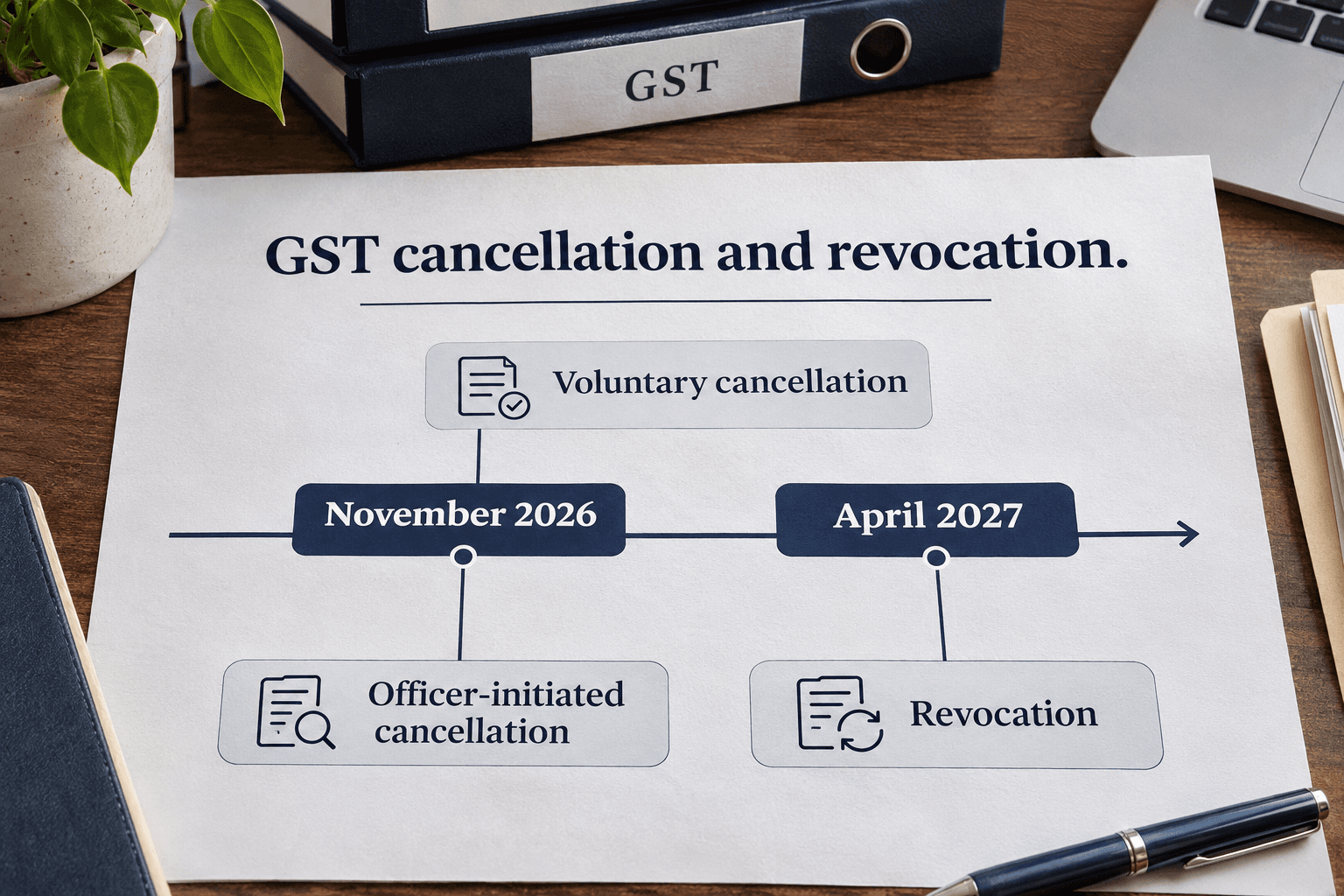
A change in a warehouse address is not simply an internal change by the seller: the operator's consent is part of the prescribed process. When consent for the principal place is withdrawn, the seller should act within the 30-day period and obtain consent for the amended address. Because a cancelled home-State GSTIN ends every linked Rule 14B registration, compliance in the home State matters as much as compliance in the destination State. Our guide to cancellation of GST registration explains how home-State cancellations arise.
Withdrawing from Rule 14B
A seller that wants to leave the scheme, for example because it has set up its own premises in the destination State or wants to make supplies there other than through an e-commerce operator, applies for withdrawal in FORM GST REG-32. Rule 14B(25) requires the application to include details of a principal place of business as proof of physical presence. Withdrawal is therefore available only once the seller has its own premises in that State; a seller without premises there cannot withdraw simply to start direct sales from the operator's warehouse. The instructions to FORM GST REG-32, as substituted by Notification No. 05/2026-Central Tax, also require returns to have been furnished for at least one tax period before a Rule 14B withdrawal application is made. Under Rule 14B(26), the application follows the procedure in sub-rules (5) to (13) of Rule 14A; if allowed, the order is issued in FORM GST REG-33.
A seller whose home-State GSTIN is under Rule 14A must first withdraw from that option. Rule 14B(15) requires such a person to submit an application in FORM GST REG-32 to withdraw from Rule 14A; read literally, the rule requires the application to be filed, not approved. In practice, however, the portal checks that the home-State GSTIN is not registered under Rule 14A, and that status changes only when the withdrawal order in FORM GST REG-33 is issued. Plan on applying under Rule 14B after REG-33. Our guide to Rule 14A registration and withdrawal covers that process.
Is Rule 14B a virtual-office facility?
No. Rule 14B is a specific registration route for eligible goods suppliers using an e-commerce operator's warehouse in another State. It does not create a general right to use any virtual-office address as a principal place of business. Circular No. 257/03/2026-GST dated 26 October 2026 sets out documentary guidance for registration applicants, including the need for an accurate and specific premises address and supporting documents. It also deals with co-working premises and different types of possession. A business should not assume that a mail-handling address or a nominal virtual office will satisfy the principal-place requirements.
Conclusion
Rule 14B can help an eligible marketplace seller obtain a GST registration in another State without leasing its own premises there. But the route is narrow: the seller must have an eligible active home-State GSTIN, keep within the ₹2.5 lakh monthly B2B output-tax threshold, supply goods through an operator collecting TCS under section 52, and obtain the operator's consent. It must also meet Aadhaar, portal and verification conditions.
Before applying, confirm the status of the home-State GSTIN, the destination-State jurisdiction, the operator's regular and TCS registrations, the B2B tax projection and the warehouse consent process. After registration, monitor the home-State registration and operator permissions, because a change in either can affect the Rule 14B GSTIN.
RESEARCH WITH ASKSOLIQUE
Rule 14B sits alongside Rule 14A, the new Rule 19 amendment process and several GSTN advisories issued in quick succession. AskSolique.ai brings GST notifications, circulars and portal advisories into one research workspace, so you can check the current rule text and trace each amendment before you file.
This article is for general information and reflects the law and GST portal guidance as at 13 November 2026. It is not legal or tax advice. Check the current rule text and portal advisories, and the facts of your case, before acting.
Frequently Asked Questions
Can I use a virtual office for GST registration instead of Rule 14B?
A virtual-office label does not by itself establish a valid principal place of business. Circular No. 257/03/2026-GST requires an accurate address and supporting premises documents, with different requirements depending on whether premises are owned, rented, held with consent or used as a co-working space. Rule 14B is a separate, limited route for eligible goods suppliers using an e-commerce operator warehouse; it is not a general virtual-office scheme.
Can service providers register under Rule 14B?
No. Rule 14B is specifically for suppliers intending to supply goods through an e-commerce operator required to collect tax at source under section 52. A service provider must examine the ordinary registration rules and any applicable exemption for services supplied through an e-commerce operator.
Where is the Rule 14B option on the GST portal?
Under Services → Registration → New Registration, in Part B of FORM GST REG-01. On the Business Details tab, the applicant selects "Yes" against the Rule 14B option and enters the eligible home-State GSTIN. On the PPoB and APoB tab, it enters the e-commerce operator GSTIN and then selects the approved warehouse address after the operator grants address access and consent.
My home-State GSTIN is under Rule 14A. Can I apply under Rule 14B?
Not while it remains under Rule 14A. Rule 14B(15) requires you to apply to withdraw in FORM GST REG-32 first. Because the portal checks the home-State GSTIN's Rule 14A status, plan on applying under Rule 14B only after the withdrawal order in FORM GST REG-33 is issued.
Can a Rule 14B registration be used for direct sales in that State?
No. The GSTN advisory states that a registration under the simplified Rule 14B scheme is to be used exclusively for supplies through e-commerce operators and not for non-e-commerce supplies. A seller that wants to make direct supplies in that State needs its own place of business there; once it has one, it can apply to withdraw from Rule 14B in FORM GST REG-32, giving those premises as proof of physical presence.
Stay in the know with AskSolique.
Occasional insights on tax, regulation, and what’s new at AskSolique. Only when we have something worth sharing.