Rule 14A GST Registration: Eligibility, the ₹2.5 Lakh Limit and Withdrawal
Last updated:
Updated 13 November 2026. The law and GST portal guidance are stated as at this date.
A business that needs a GST registration quickly may consider Rule 14A, but the faster route comes with a limit. The rule allows an eligible applicant to obtain registration electronically within three working days after successful Aadhaar authentication, provided the applicant expects its output tax liability on supplies to registered persons to remain within ₹2.5 lakh a month. The limit is based on tax, not turnover. This article explains who can opt for Rule 14A, how the threshold works, and what a business must do before withdrawing from the option.
KEY TAKEAWAYS
- Rule 14A, in force since 1 November 2025, is an optional route selected in Part B of FORM GST REG-01.
- Registration is granted electronically within three working days of the application, once Aadhaar authentication succeeds.
- Output tax on supplies to registered persons must stay within ₹2.5 lakh a month. Supplies to unregistered customers do not count.
- To exceed the limit, the business must withdraw in FORM GST REG-32, and the higher amount applies only from the month after the withdrawal order. Every supply must still be reported at its actual value.
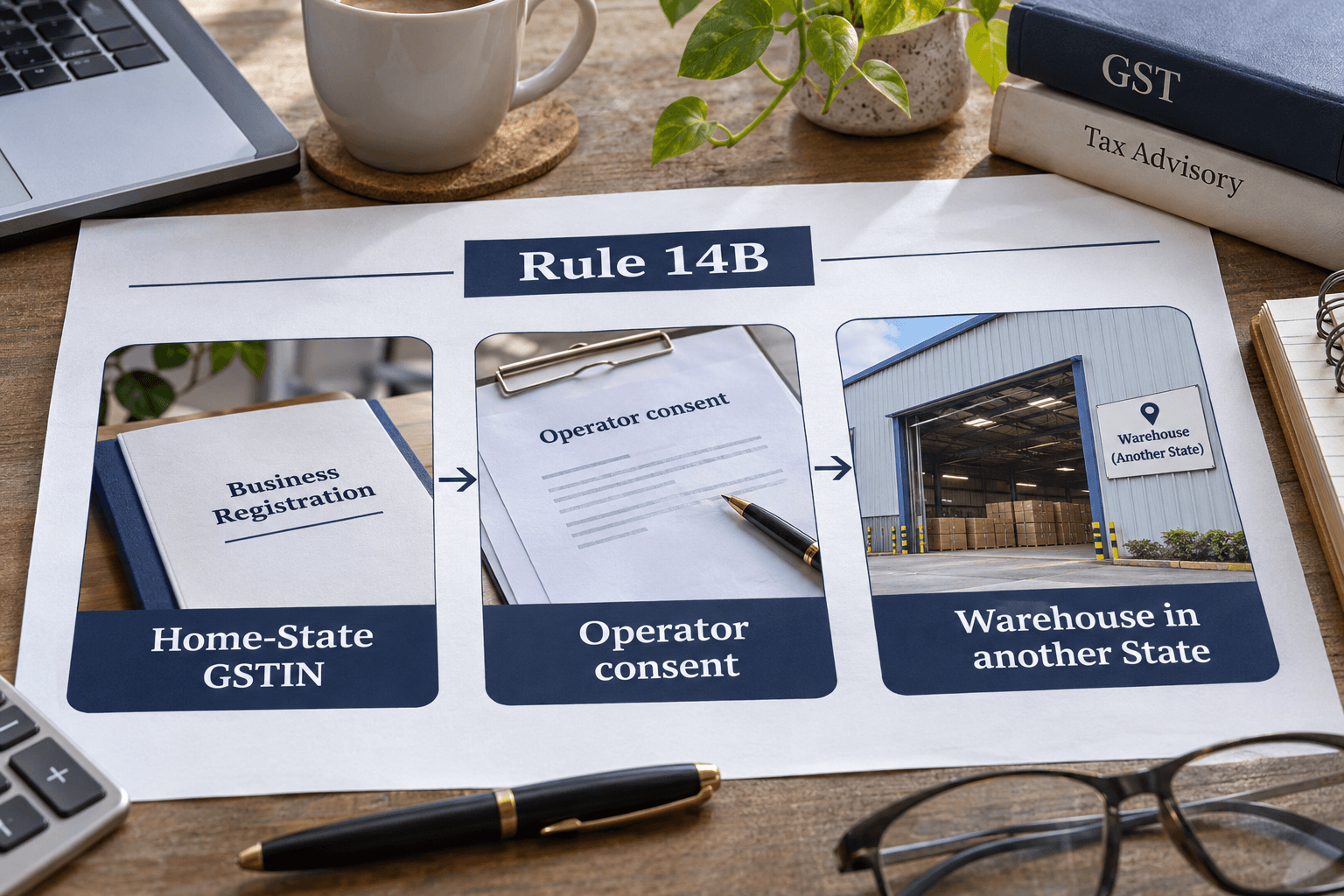
- A Rule 14A GSTIN cannot be the home-State registration for a Rule 14B e-commerce registration in another State.
Where Rule 14A comes from
Rule 14A was inserted into the Central Goods and Services Tax Rules, 2017 by Notification No. 18/2025-Central Tax dated 31 October 2025 (G.S.R. 805(E)), with effect from 1 November 2025. It is an optional route for an applicant who has applied for registration under Rule 8. The option is selected in Part B of FORM GST REG-01; there is no separate application for the initial registration.
The three-working-day timeline is conditional. Under Rule 14A(4), the common portal grants registration electronically within three working days from the date of submission of the application upon successful Aadhaar authentication. An applicant who is not exempt under section 25(6D) must opt for Aadhaar authentication. If the prescribed authentication or verification is incomplete, the applicant should not treat three working days as an unconditional approval guarantee.
Who can opt for Rule 14A
The option is available to a person applying for registration under Rule 8 who determines that the total output tax liability on supplies of goods, services or both made to registered persons will not exceed ₹2.5 lakh per month. The calculation aggregates central tax, State tax or Union territory tax and integrated tax. The rule text also lists compensation cess; the note below explains why that rarely matters now.
- The applicant must be seeking registration under Rule 8. Rule 14A is an option at the new-registration stage; it is not a conversion procedure for an existing GSTIN.
- The monthly B2B output-tax limit must be met. The test is tax on supplies to registered persons, not the value of all sales or total turnover.
- Aadhaar authentication must be opted for. This condition does not apply to a person notified under section 25(6D).
- Only one Rule 14A registration is permitted per PAN in a State or Union territory. The restriction is State- or UT-specific; it is not a single Rule 14A registration for the PAN across India.
The applicant should make and retain a reasonable projection of its B2B supplies and related tax before selecting the option. A business with a large consumer-facing turnover may still fall within the limit if its tax liability on supplies to registered customers remains within the threshold. Conversely, a business with comparatively modest turnover may exceed the threshold if a substantial portion of its supplies is to registered persons.
How the ₹2.5 lakh limit works
The threshold is a monthly tax-liability test. It is not a ₹2.5 lakh turnover limit. Supplies to unregistered customers do not enter this particular calculation. Supplies to registered persons are considered, and the tax components specified in Rule 14A are aggregated.
For a simple illustration, if all relevant B2B supplies attract GST at the 18% standard rate, a tax amount of ₹2.5 lakh corresponds to taxable value of about ₹13.89 lakh. At the 5% merit rate, it corresponds to taxable value of ₹50 lakh. Actual eligibility must be calculated using the rates that apply to each supply.
Example. A new design studio in Chennai expects to bill ₹6 lakh a month to GST-registered business clients at 18% and ₹4 lakh to individuals. Its B2B output tax is ₹1.08 lakh, so it qualifies. If its business billing grows to ₹14 lakh a month, the B2B tax becomes ₹2.52 lakh, which is over the limit. The studio should apply to withdraw as soon as it expects that growth, so that the withdrawal order is in place before its B2B billing crosses the threshold.
A note on compensation cess. Rule 14A's text includes compensation cess in the calculation. GST compensation cess, however, ceased to be levied from 1 February 2026, when it was replaced on the remaining tobacco and pan masala products by levies outside GST. For an applicant estimating its liability today, compensation cess therefore adds nothing to the total.
The limit also affects when a business can expand its B2B tax liability. Filing a withdrawal application does not lift the limit: a liability above the Rule 14A threshold is permitted only from the first day of the month succeeding the month in which the proper officer issues the order allowing withdrawal, and earlier periods cannot be amended to exceed it.
If the limit is crossed before withdrawal. None of this means tax can be left off a return. If actual B2B supplies in a month push output tax above ₹2.5 lakh before withdrawal takes effect, those supplies must still be reported and the tax paid on their actual value. Rule 14A does not spell out the consequence of breaching the condition, so the registrant should apply to withdraw immediately and take professional advice on its position.
Rule 14A compared with the other registration routes
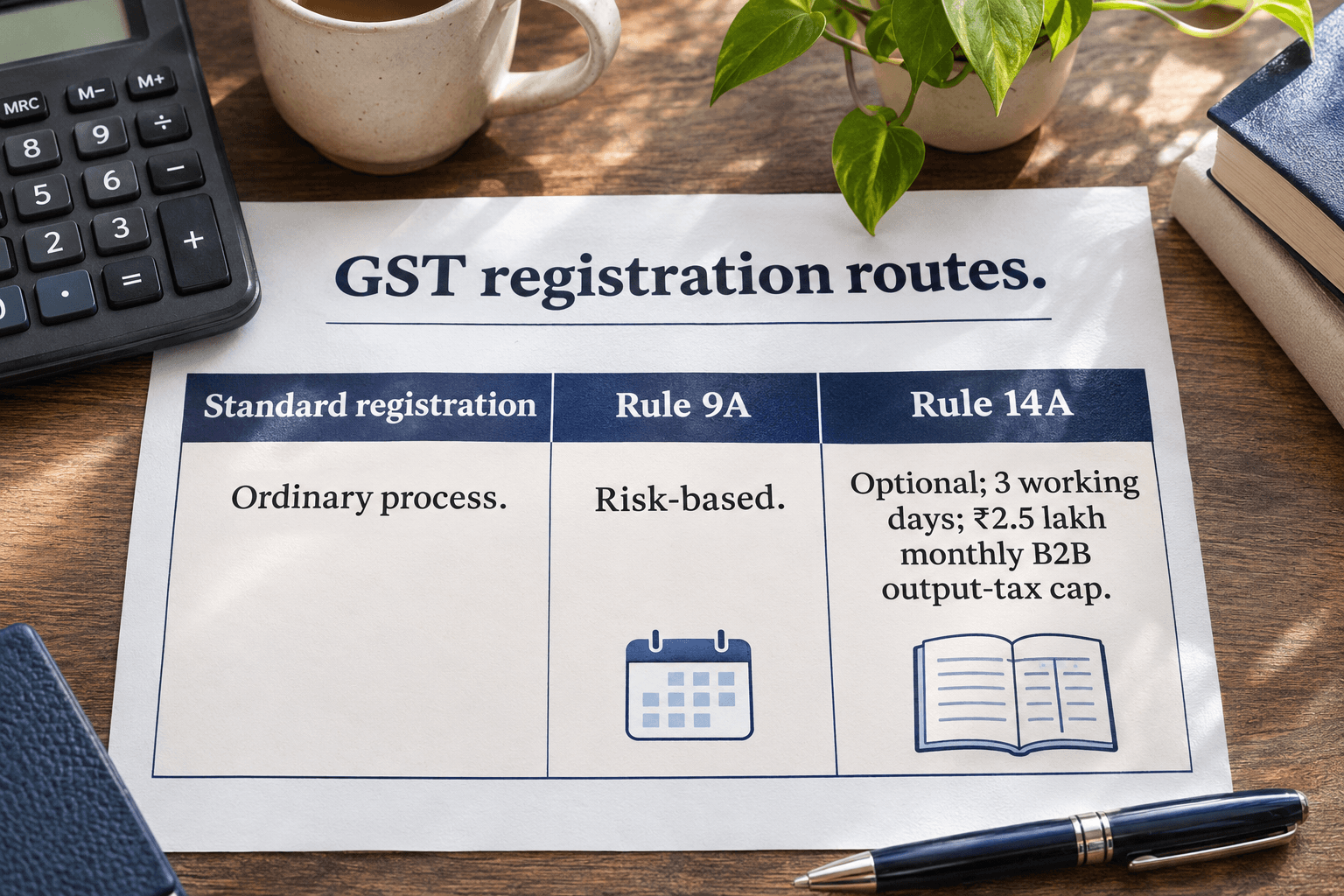
| Route | How it is selected | Processing timeline | B2B tax cap |
|---|---|---|---|
| Standard registration (Rule 9) | Default route for an applicant under Rule 8. | Generally 7 working days; up to 30 days where physical verification or other prescribed checks are required. | No Rule 14A-specific ₹2.5 lakh cap. |
| Rule 9A | The common portal identifies the application using data analysis and risk parameters; the applicant does not elect this route. | Electronic grant within 3 working days from submission when identified. | No Rule 14A-specific ₹2.5 lakh cap. |
| Rule 14A | The applicant elects the option in Part B of REG-01 and meets the eligibility conditions. | Electronic grant within 3 working days from submission upon successful Aadhaar authentication. | ₹2.5 lakh of aggregate monthly output tax on supplies to registered persons. |
Circular No. 257/03/2026-GST dated 26 October 2026 restates these routes for applicants: ordinary processing within seven working days, thirty days where physical verification is required, and three working days for the electronic routes.
Rule 9A and Rule 14A should not be confused. Rule 9A applies when the common portal identifies an application on the basis of data analysis and risk parameters. Rule 14A is an option chosen by the applicant and carries the specific monthly B2B output-tax limit. A business that expects to exceed the limit soon may prefer the standard route rather than incur the additional withdrawal process.
Withdrawing from Rule 14A
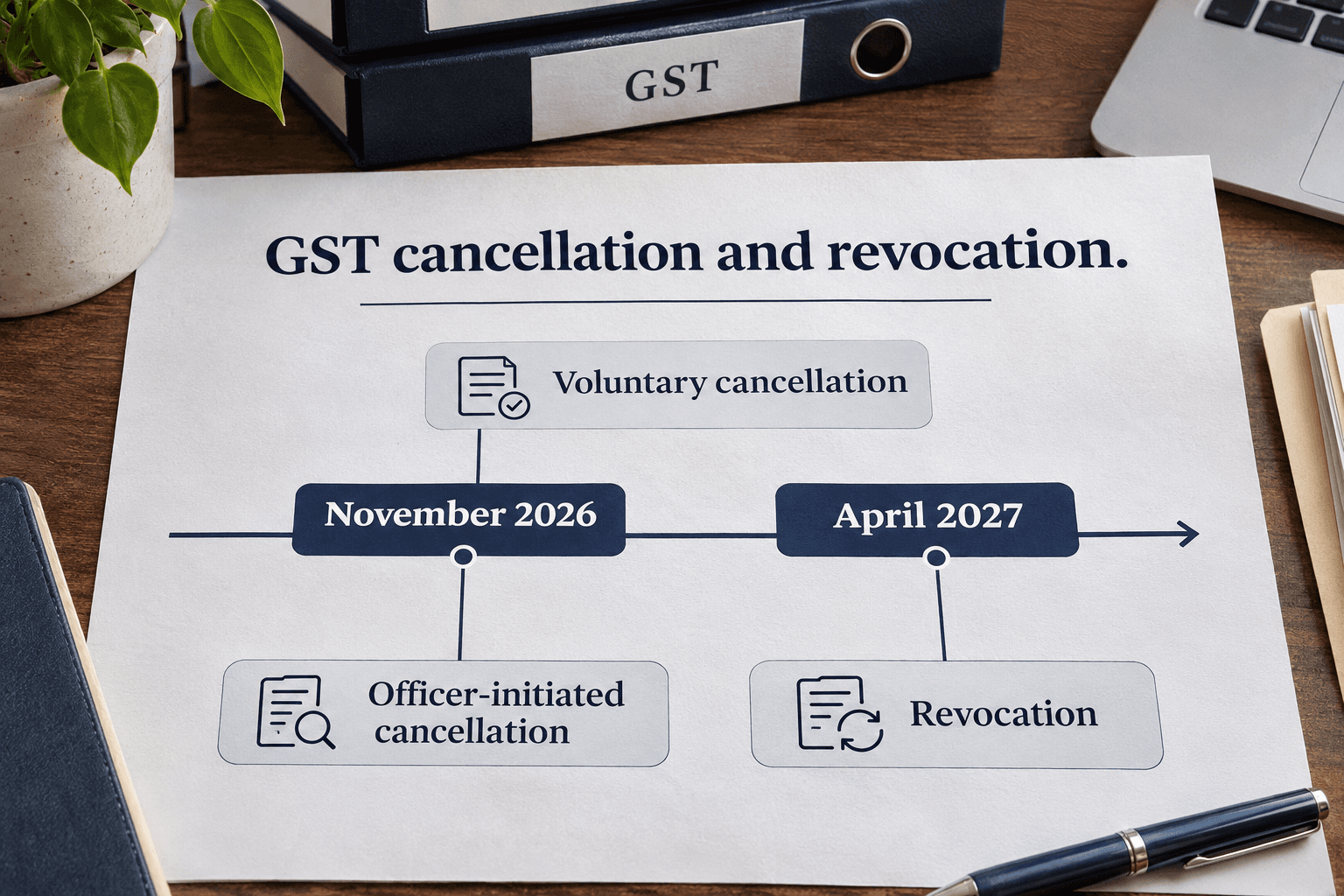
A registrant that expects to exceed the limit, or otherwise wants to leave the option, must apply in FORM GST REG-32. For an application filed on or after 1 April 2026, the registrant must have furnished returns for at least one tax period and all returns due from the effective date of registration up to the date of the withdrawal application. The earlier minimum of three months applied to applications filed before 1 April 2026.
- Update registration particulars first. Any change to particulars furnished in REG-01 must be amended under Rule 19 before REG-32 is filed.
- Check for pending returns and amendments. All returns due up to the application date must be furnished. The form instructions also require that no amendment application be pending when REG-32 is filed.
- Check cancellation proceedings. The application cannot be filed where proceedings under section 29 have been initiated. If cancellation proceedings are initiated after the withdrawal application is filed and remain pending, the withdrawal application is liable to be rejected. Our guide to cancellation of GST registration explains how those proceedings work.
- Allow time for verification. The application is verified under Rule 9. The three-working-day timeline for the original Rule 14A registration does not apply to withdrawal as a guaranteed processing period.
If the application is allowed, the proper officer issues FORM GST REG-33. If it is rejected, the order is communicated in FORM GST REG-05. Once the withdrawal order is issued, the registrant may report B2B output tax above the Rule 14A limit only from the first day of the succeeding month. Until then, the earlier cap continues to apply.
Changes from November and December 2026
Notification No. 05/2026-Central Tax dated 26 October 2026 substituted Rule 19 with effect from 1 November 2026. For all registrants, changes to registration particulars other than the principal place of business now take effect on submission of FORM GST REG-14 and successful online validation. A change in the principal place of business is still examined by the proper officer. Under the substituted Rule 19(1), the amendment application in FORM GST REG-14 must be filed within 15 days of the change.
From 1 December 2026, Rule 19(3) goes further for a Rule 14A registrant that has not withdrawn from the option: even a change in its principal place of business stands amended on submission and completion of online validation. This is a practical advantage for a small business that relocates soon after registering.
A Rule 14A registration also affects marketplace expansion. A Rule 14A GSTIN cannot serve as the home-State registration for a Rule 14B registration using an e-commerce operator's warehouse in another State. The business must apply to withdraw in REG-32 and, as a practical matter, should wait for the withdrawal order in REG-33 before applying under Rule 14B.
Conclusion
Rule 14A is useful for a new business that needs a GSTIN quickly and expects its monthly output tax on supplies to registered customers to remain within ₹2.5 lakh. The threshold is calculated on tax, not turnover. Before opting in, the applicant should estimate its B2B supplies by tax rate and document the projection. A business expecting rapid B2B growth, or planning to sell through marketplace warehouses in other States, should consider whether the standard registration route would avoid a time-sensitive withdrawal process later.
RESEARCH WITH ASKSOLIQUE
Choosing between Rule 9, Rule 14A and Rule 14B depends on rule text that has changed several times since November 2025. AskSolique.ai brings GST notifications, circulars and portal advisories into one research workspace, so you can check the current position quickly before advising a client or filing.
This article is for general information and reflects the law and GST portal guidance as at 13 November 2026. It is not legal or tax advice. Check the current rule text and portal advisories, and the facts of your case, before acting.
Frequently Asked Questions
Is Rule 14A registration mandatory for small businesses?
No. Rule 14A is an option that an eligible applicant may select in FORM GST REG-01. A small business may use the standard registration route instead. The choice should be made deliberately because leaving Rule 14A later requires a withdrawal application and an order from the proper officer.
Can an existing GST registrant switch to Rule 14A?
Rule 14A is framed for an applicant seeking registration under Rule 8 and does not prescribe a process for converting an existing GSTIN to Rule 14A. An existing business may consider the option when applying for a separate registration in a State or Union territory where it is not already registered, subject to the conditions and the one-registration-per-PAN-per-State/UT restriction.
How long does Rule 14A withdrawal take?
The withdrawal application in FORM GST REG-32 is verified under Rule 9. The ordinary Rule 9 verification and processing provisions apply; the three-working-day timeline for the original Rule 14A registration is not a guaranteed withdrawal timeline. The proper officer issues FORM GST REG-33 if withdrawal is allowed or FORM GST REG-05 if it is rejected.
When can a Rule 14A registrant report B2B tax above ₹2.5 lakh?
Only from the first day of the month succeeding the month in which the order allowing withdrawal is issued. Filing FORM GST REG-32 by itself does not remove the limit, and earlier periods cannot be amended to exceed it. If B2B supplies actually exceed the limit earlier, they must still be reported and the tax paid; apply to withdraw immediately and take advice.
How do I check the status of a Rule 14A application?
Use the application reference number on the GST portal under the application-status tracking facility. The three-working-day period under Rule 14A runs subject to successful Aadhaar authentication. If the application is delayed, check whether the required authentication or other portal verification remains incomplete.
Stay in the know with AskSolique.
Occasional insights on tax, regulation, and what’s new at AskSolique. Only when we have something worth sharing.