Corporate Governance in India: How the Companies Act, 2013 and SEBI LODR Apply Together
Last updated:
Corporate governance in India is not a single code, because it is assembled from the Companies Act, 2013, the SEBI (Listing Obligations and Disclosure Requirements) Regulations, 2015 (LODR) and the Secretarial Standards, and each applies to a different set of entities on its own conditions. A private company answers to the Act and the Standards alone, a listed company answers to all three, and a small listed entity may be excused from parts of LODR but not from the Act. Boards and advisers who treat corporate governance as one checklist tend to miss those conditions. This article sets out who each source covers, where they overlap and how they interact.
Three sources, three sets of entities
The Companies Act, 2013, administered by the Ministry of Corporate Affairs, applies to companies generally, with many governance provisions confined to listed companies or to public companies above prescribed limits. LODR applies to listed entities and is enforced by SEBI and the stock exchanges. The Secretarial Standards, SS-1 on board meetings and SS-2 on general meetings, are issued by the Institute of Company Secretaries of India and are binding on companies under section 118(10) of the Act. The revised standards took effect on 1 April 2024.
Applicability, provision by provision
| Topic | Companies Act, 2013 | SEBI LODR |
|---|---|---|
| Independent directors | Section 149(4): one-third of the board for every listed public company. Rule 4: at least two for public companies with paid-up capital of ₹10 crore or more, turnover of ₹100 crore or more, or outstanding loans, debentures and deposits above ₹50 crore, with exceptions | Regulation 17(1): one-third where the chair is a non-executive director; one-half where there is no regular non-executive chair or the chair is a promoter or related to one |
| Woman director | Section 149(1) and Rule 3: listed companies, and other public companies with paid-up capital of ₹100 crore or more or turnover of ₹300 crore or more | Regulation 17(1): at least one woman director; an independent woman director for the top 1,000 listed entities |
| Independent director tenure | Section 149: up to two consecutive five-year terms, then a three-year gap | Regulation 25(2): tenure as per the Act |
| Board meetings | Section 173: at least four a year, no more than 120 days apart; one meeting in each half-year, at least 90 days apart, suffices for one person, small and dormant companies | Regulation 17(2): at least four a year, no more than 120 days apart |
| Audit committee | Section 177 and Rule 6: listed companies and public companies meeting the Rule 6 limits (the same figures as Rule 4); at least three directors, independent directors forming a majority | Regulation 18: at least three directors, two-thirds of them independent |
| Secretarial audit | Section 204 and Rule 9: listed companies and prescribed others, including public companies with paid-up capital of ₹50 crore or more or turnover of ₹250 crore or more | Regulation 24A: listed entities and material unlisted subsidiaries in India; peer-reviewed company secretary, shareholder approval at the AGM, one five-year term for an individual and two for a firm |
Regulation 15(2) qualifies the LODR column. It excuses a listed entity with paid-up equity capital not exceeding ₹10 crore and net worth not exceeding ₹25 crore, and one listed on an SME exchange, from the corporate governance regulations it lists, subject to a six-month compliance window if the limits are later crossed. That excusal is from LODR only. A listed company below those limits still meets section 149, section 177 and section 204 as they apply to a listed company.
How the two rulebooks interact
The Act and LODR apply cumulatively, neither displacing the other, and they interact in three ways. Sometimes LODR adopts the Act, as Regulation 25(2) does for tenure. Sometimes it sets a different standard for the same subject, as with the audit committee, where the Act requires a majority of independent directors and LODR two-thirds. And sometimes the two regulate the same transaction through different mechanisms.
Related party transactions are the clearest example. Section 188 of the Act works through board approval and, above prescribed limits, shareholder approval, and it excludes transactions in the ordinary course of business at arm's length from those approvals. Regulation 23 works through audit committee approval and shareholder approval of material transactions, and its shareholder requirement does not turn on arm's-length or ordinary-course status. A transaction cleared under one provision can therefore still need approval under the other, as the note on related party transactions under the Companies Act and SEBI LODR shows.
The practical rule is therefore not that one source prevails. A listed company must satisfy each provision that applies to it on that provision's own terms, and read the exemptions separately. Where the numbers overlap, as with the audit committee, satisfying the higher standard will usually satisfy both, but only after checking that the lower one has no condition of its own.
Directors' duties sit outside the table
Structure is the visible part of governance and conduct is the rest. Section 166 of the Companies Act requires a director to act in good faith to promote the company's objects for the benefit of its members as a whole, to exercise due and reasonable care, skill, diligence and independent judgment, and to avoid conflicts of interest and undue personal gain. A director who contravenes section 166 is punishable with a fine of ₹1 lakh to ₹5 lakh. The board's report also carries the directors' responsibility statement under section 134(5), which for a listed company includes a statement on internal financial controls.
The evidence that a board has met these duties is mostly documentary, in minutes that record what was discussed, decided and declared. Timelines are a common weak point, and prior intimation of board meetings under SEBI LODR Regulation 29 is one example. A single dated calendar, such as the SEBI LODR compliance calendar for listed entities, is more reliable than memory.
What is not yet law
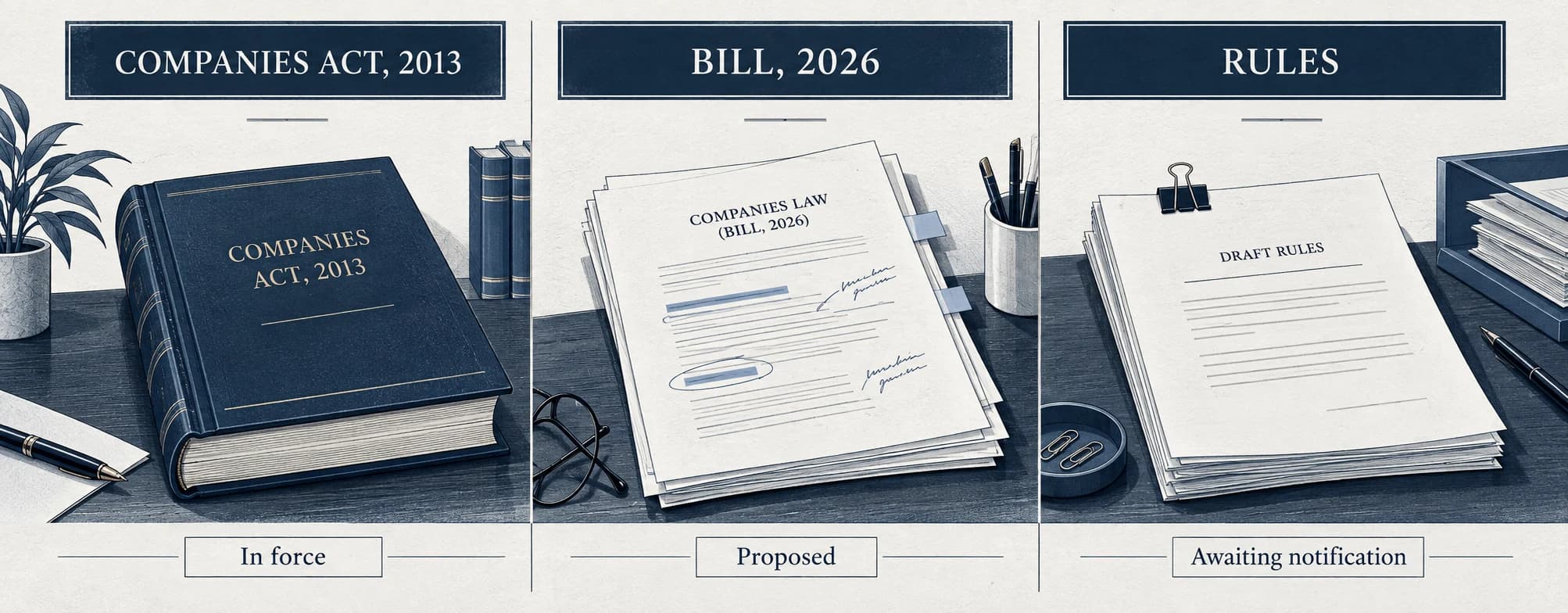
The Corporate Laws (Amendment) Bill, 2026 is pending and has not been enacted, so the provisions above are stated as they stood on 21 September 2026. Which of its proposals touch governance, and in what form, is set out in what the corporate law amendment bill 2026 changes and what remains proposed. Nothing in the Bill as introduced should be read into the table until it is enacted and brought into force.
The short answer
Corporate governance in India rests on the Companies Act, 2013, the Secretarial Standards and, for listed entities, LODR, each applying on its own conditions and cumulatively rather than by one prevailing over the other. Your next step is to test your entity against the table: which limits it meets, which regulations it is excused from, and which approvals each source requires. For company secretaries who keep this calendar, AskSolique's tools for company secretaries are built around section-level sources.
Frequently Asked Questions
What is corporate governance in simple words?
Corporate governance is the system by which a company is directed and held to account. It covers how the board is composed and behaves, how decisions are recorded, how information reaches shareholders, and how minority investors are treated. In India it comes from the Companies Act, securities regulation and professional standards rather than from one code.
Does corporate governance law apply to private companies?
In part. A private company follows the Companies Act provisions that apply to companies generally, including directors' duties under section 166, board meeting and filing requirements, and the Secretarial Standards under section 118(10). The independent-director, woman-director and audit-committee provisions attach to listed companies and to public companies above prescribed limits, so they do not reach a private company as such.
Who enforces corporate governance rules in India?
It depends on the source. The Ministry of Corporate Affairs enforces the Companies Act through the Registrar of Companies, Regional Directors and the NCLT. SEBI and the stock exchanges enforce LODR for listed entities. NFRA oversees audit quality, and professional institutes can discipline their members, so one lapse can involve more than one authority.
Does Regulation 15(2) take a small listed company out of the Companies Act?
No. Regulation 15(2) excuses certain listed entities from the corporate governance regulations of LODR that it lists. It does not amend the Companies Act. A listed company still meets the Act's provisions for listed companies, such as section 149, section 177 and section 204, and the Secretarial Standards, even where LODR excuses it.
What does a company secretary do in corporate governance?
A company secretary advises the board on compliance, maintains statutory records and helps the company follow the Secretarial Standards on meetings. Section 203 and the rules made under it require a whole-time company secretary in listed companies and in certain other companies, and Regulation 6 of LODR requires a listed entity's compliance officer to be a qualified company secretary.
Stay in the know with AskSolique.
Occasional insights on tax, regulation, and what’s new at AskSolique. Only when we have something worth sharing.