Corporate Veil in India: Where Separate Personality Ends and Personal Liability Begins
Last updated:
A supplier is unpaid, the company that signed the contract has no assets, and the supplier's counsel writes to the director personally. Whether that letter has any legal basis depends on what the corporate veil is, and on which of several distinct doctrines is being invoked. Indian law uses the same metaphor for separate personality, for a court's decision to disregard a company, for statutes that impose personal liability, and for fraudulent or wrongful trading. This article separates them for promoters, directors and advisers, because the corporate veil is not lifted by a single rule, and the consequences differ with the route.
Separate personality is the starting rule
In Salomon v A Salomon & Co Ltd [1897] AC 22, the House of Lords held that a company is a legal person distinct from its members, even where one person holds virtually all the shares. Section 9 of the Companies Act, 2013 gives effect to that rule for Indian companies: on incorporation the subscribers become a body corporate that can hold property, contract, and sue and be sued in its own name. Under section 2(22), the liability of members of a company limited by shares is limited to any amount unpaid on their shares. This corporate personality in company law is the default, and each route below is an exception to it.
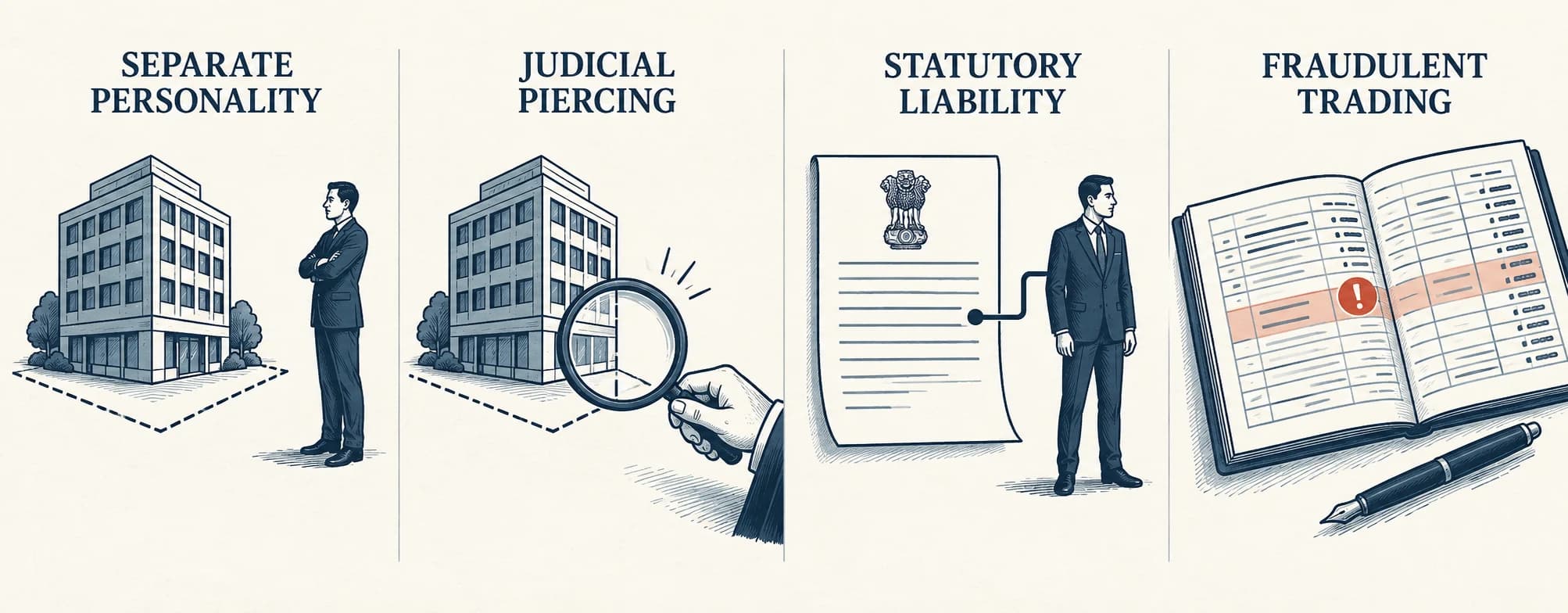
Four ideas that are often run together
| Idea | Source | What it does | Who may invoke it |
|---|---|---|---|
| Separate personality | Section 9; Salomon | Makes the company, not its members, the party to its contracts and the bearer of its liabilities | Not invoked; it is the default |
| Judicial piercing or lifting | Case law | A court disregards or looks behind the company on the facts before it | A party to litigation |
| Statutory personal liability | Section 7(6) and 7(7) | Where incorporation was obtained by false information, suppression of a material fact or fraudulent action, the Tribunal may make members' liability unlimited, regulate management, remove the name or order winding up; those responsible are liable under section 447 | Application to the Tribunal |
| Fraudulent or wrongful trading | Section 339; IBC section 66 | Makes persons personally responsible for company debts (section 339) or liable to contribute to its assets (section 66) | Liquidator, creditor or contributory (section 339); resolution professional (section 66) |
Only the second row is a judicial doctrine. The third and fourth are creations of statute, which fix their own triggers, remedies and applicants, and none of them requires a court to decide first that separate personality should be set aside. Section 7(7) is the only one of these provisions that can reach the limited liability of members themselves. Sections 339 and 66 impose liability on individuals for their own conduct of the business.
Fraudulent and wrongful trading also differ from each other. Section 339 of the Companies Act and section 66(1) of the Insolvency and Bankruptcy Code (IBC) require business carried on with intent to defraud creditors or for a fraudulent purpose. Section 66(2) is different in kind, because it asks what a director knew or ought to have known about the prospect of avoiding insolvency and whether due diligence was exercised to minimise loss to creditors. Fraud is not an element of that second limb.
What the courts have held
English authority is the usual starting point. In Prest v Petrodel Resources Ltd [2013] UKSC 34, Lord Sumption said that a company's separate personality can be disregarded where a person under an existing legal obligation deliberately evades or frustrates it by interposing a company under their control. The court did not pierce the veil on the facts of that case, since the property was held on trust, and it treated piercing as a last resort.
Indian courts have described the circumstances rather than laid down a formula. In Life Insurance Corporation of India v Escorts Ltd (1986) 1 SCC 264, the Supreme Court surveyed situations in which courts have looked behind a company, such as fraud, improper conduct and evasion of welfare legislation, but it did not lift the veil on the facts before it, and the survey is not a closed list. In Delhi Development Authority v Skipper Construction Co (P) Ltd (1996) 4 SCC 622, a case of fraud on flat buyers, the Court refused to let the corporate form shelter those who had carried out the fraud.
The restraint is equally clear. Vodafone International Holdings BV v Union of India (2012) 6 SCC 613 stressed that piercing is exceptional and that a holding structure is not disregarded merely because it has tax consequences. Balwant Rai Saluja v Air India Ltd (2014) 9 SCC 407 reviewed Prest and Escorts and held that ownership and control of one company by another is not by itself a reason to disregard the subsidiary's separate personality. No judgment supplies a fixed test, so each outcome turns on its own facts.
Where the statute reaches individuals
Section 7(7) sits at the point of incorporation. It applies where the company was incorporated by furnishing false or incorrect information, suppressing a material fact or fraudulent action, and it leaves the Tribunal a range of orders, one of which is unlimited liability for members. Section 7(6) separately exposes those who furnished the false information to action under section 447. Neither provision is about how the company was run later.
Section 339 operates in winding up under the Companies Act. Where business was carried on with intent to defraud creditors or for a fraudulent purpose, the Tribunal may declare those who were knowingly parties personally responsible, without limit of liability, for the debts it directs, and section 339(3) attracts section 447. IBC section 66 operates in insolvency proceedings under the Code and orders contribution to the corporate debtor's assets. Ordinary defaults by an officer in default are different again, as the note on everyday Companies Act lapses the ROC acts on explains.
What this means for group structures
Because courts decide on facts, the record matters. Separate board approvals, contracts in the company's own name and accounts that keep group entities apart do not guarantee that a court will respect separateness, but they leave little for an allegation of sham to rest on. Dealings between group entities test this hardest, which is why the interplay of laws governing related party transactions matters here. Disclosure of significant beneficial ownership under the Companies Act, 2013 does not lift the veil, but it shows who stands behind a company.
The short answer
The corporate veil is not one doctrine. Separate personality is the rule; a court may disregard it only on the facts of a particular case; sections 7(7) and 339 and IBC section 66 are statutory routes with their own triggers, applicants and remedies; and no Indian judgment fixes a formula. Before advising, identify which route is being asserted and read its text. To check a citation or a section against the source, AskSolique's Research Centre returns cited answers.
Frequently Asked Questions
What is the corporate veil meaning in company law?
The corporate veil is the legal separation between a company and the people who own and run it. Because the company is a distinct legal person, its debts and obligations are its own, and members are not liable for them beyond what they owe on their shares. The phrase is a judicial metaphor, not a term defined in the Companies Act, 2013.
What is a body corporate under the Companies Act, 2013?
Section 2(11) says a body corporate includes a company incorporated outside India, but excludes co-operative societies registered under co-operative law and any other body the Central Government notifies. A company registered under the Act becomes a body corporate through section 9. A limited liability partnership is separately a body corporate under the LLP Act, 2008, and is not a company.
Does a personal guarantee pierce the corporate veil?
No, because the veil is not involved. A promoter who signs a personal guarantee is liable on their own contract with the lender, and under the Indian Contract Act a surety's liability is co-extensive with the principal debtor's unless the contract says otherwise. Separate personality protects a promoter from the company's liabilities, not from obligations the promoter takes on personally.
Can directors be personally liable for a company's debts?
Not merely because they are directors. A company's contracts bind the company. Directors become personally liable for their own acts, for example where they sign personally or give a guarantee, or where a Tribunal makes an order under section 339 of the Companies Act or section 66 of the IBC. Liability as an officer in default for statutory contraventions is a separate matter.
What is the difference between lifting and piercing the corporate veil?
Some writers distinguish them. On that view, lifting means looking behind the company to establish facts, such as who controls it, while piercing means disregarding its separate personality to fix liability on those behind it. Judgments and articles often use the words interchangeably, so read the reasoning in each decision rather than relying on the label.
Stay in the know with AskSolique.
Occasional insights on tax, regulation, and what’s new at AskSolique. Only when we have something worth sharing.
Recent Blog Posts
See All Posts