Corporate Law Amendment Bill 2026: What Is Law, What Is Proposed and What Awaits Rules
Last updated:
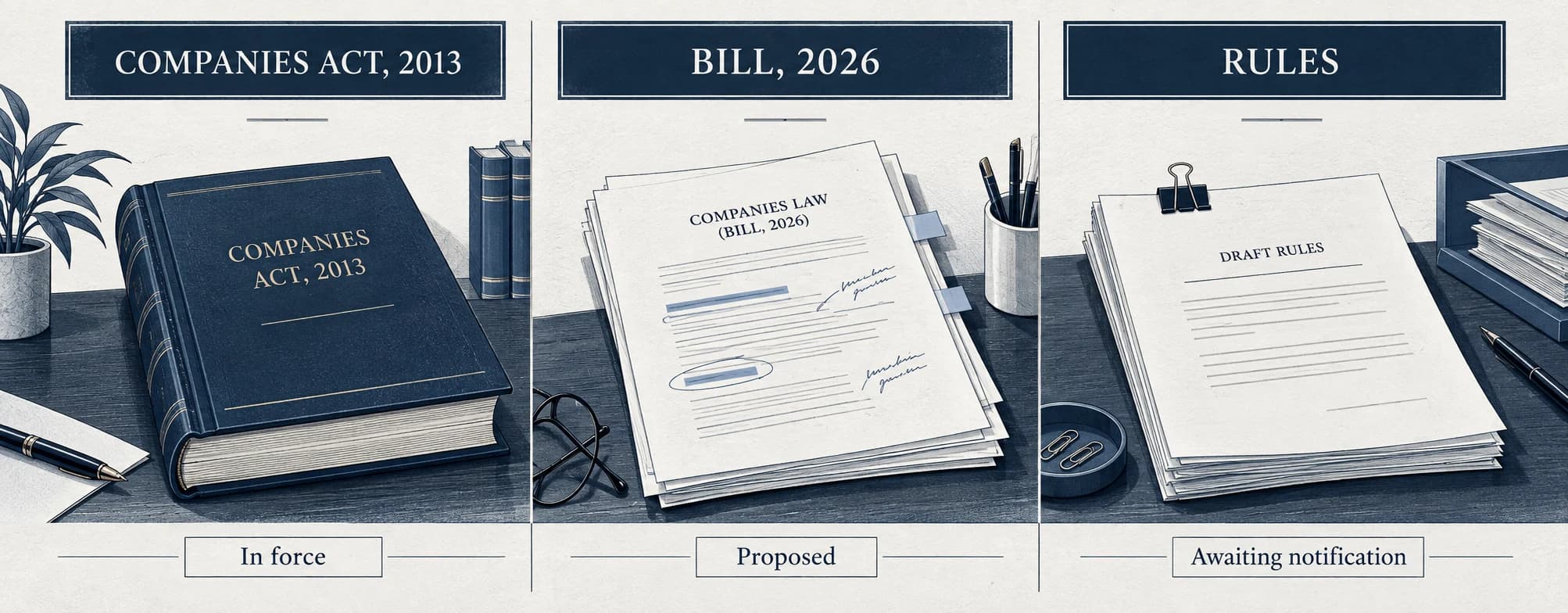
The Corporate Laws (Amendment) Bill, 2026 is often reported as though it had already changed the Companies Act, 2013, but it has not. The corporate law amendment bill 2026 was introduced in the Lok Sabha on 23 March 2026 and examined by a Joint Committee of Parliament, and as of 21 September 2026 it has not been enacted. Company secretaries and counsel who need to test the corporate law amendment bill 2026 against existing obligations must keep four things apart: the law in force, the Bill as introduced, the Committee's recommendations, and the provisions that would still need notification or rules. This article follows that order.
Status of the Bill
The Bill is Bill No. 85 of 2026, introduced by the Ministry of Corporate Affairs and referred to a Joint Committee of both Houses. The Committee presented its report on 3 August 2026. The Monsoon Session ended on 13 August 2026 without the Bill being passed, and we have found no record of passage by either House or of Presidential assent as on 21 September 2026. Until a Bill is passed by both Houses, assented to by the President and brought into force, every section it touches continues to read as it does today.
Law in force compared with the Bill as introduced
| Provision | Law in force | Bill as introduced |
|---|---|---|
| Small company, section 2(85) | Paid-up capital up to ₹10 crore and turnover up to ₹100 crore, under the prescribed figures effective 1 December 2025 (G.S.R. 880(E)). Holding and subsidiary companies, section 8 companies and companies under a special Act are excluded | Limits of ₹20 crore paid-up capital and ₹200 crore turnover |
| CSR applicability, section 135(1) | Applies if, in the immediately preceding financial year, any one of these is met: net worth of ₹500 crore or more, turnover of ₹1,000 crore or more, or net profit of ₹5 crore or more | Net-profit limit becomes ₹10 crore or a prescribed sum; net worth and turnover limits unchanged |
| CSR committee, section 135(9) | Not required where the amount to be spent does not exceed ₹50 lakh | Limit becomes ₹1 crore or a higher prescribed amount |
| Unspent CSR, ongoing project, section 135(6) | Transfer to the Unspent CSR Account within 30 days from the end of the financial year | 90 days |
| CSR exemption, new section 135(10) | None | Prescribed classes of companies exempt |
| Fast-track merger, section 233(1) | Members holding at least 90% of the total number of shares approve; creditors representing nine-tenths in value | A majority of members present and voting who hold at least 75% of the value of shares held by those members; creditors at three-fourths in value (Clause 69) |
| AGM format, section 96 | The section does not itself provide for virtual meetings, which have run on MCA general circulars | Physical, or through video conferencing or other audio-visual means, wholly or partly, as prescribed (Clause 32) |
| Employee schemes, section 62(1)(b) | Scheme of employees' stock option, on prescribed conditions | Adds "such other scheme linked to the value of the share capital of the company" (Clause 28) |
Three of these rows are easy to over-read. Section 135(1) is triggered by any one of three limits, so a higher net-profit figure relieves only a company that also stays below ₹500 crore of net worth and ₹1,000 crore of turnover. The 90-day period in section 135(6) applies to the transfer of unspent amounts for an ongoing project, not to unspent CSR amounts generally. Applicability, the committee requirement and unspent-amount treatment each turn on a different sub-section, as the CSR provisions of the Companies Act, 2013 show.
The fast-track change is often summarised as a cut from 90% to 75%, but the text is more specific. The member test moves from a share of all shares to a majority of those present and voting who hold at least 75% of the value of the shares held by them, and the creditor test moves from nine-tenths to three-fourths in value. Clause 69 does not create an exit right for dissenting shareholders, and section 233 stays confined to the classes of company it lists. Approval is also only the first step, since the tax and reporting consequences of a merger follow separately.
What the Joint Committee has done
The Committee's report is a set of recommendations that amends neither the Bill nor the Act. A recommendation takes effect only if the Government moves it as an amendment and both Houses pass the Bill in that form. The Committee's views on the clauses tabulated above should therefore be read in the report itself, on Parliament's website, before any figure in this article is relied on. Until then, the Bill as introduced is best treated as a proposal that may still change.
What would still need notification, rules or prescribed conditions
Even an enacted Bill does not operate on its own. Commencement depends on what the enacted Act says, and where it is left to notification, different provisions can come into force on different dates. Several proposals are also incomplete without rules made by the Central Government and published through the Ministry of Corporate Affairs. These include the alternative "prescribed" CSR profit figure, the higher CSR committee limit, the classes exempted under proposed section 135(10), the manner in which a meeting may be held through video conferencing, and any conditions attached to a new employee scheme.
For listed entities, meeting and disclosure timelines under SEBI's listing regulations run separately from section 96, and the SEBI LODR compliance calendar for listed entities remains the reference for them. Small-company status today follows the figures effective from 1 December 2025, not those in the Bill. The board-level duties in force are set out in corporate governance in India under the Companies Act and SEBI LODR.
The short answer
The corporate law amendment bill 2026 is a proposal, not law. The Companies Act, 2013 and its rules govern as they stand; the Bill as introduced would change thresholds, timelines and procedures in the provisions above; the Committee's recommendations bind no one until adopted; and several changes would still depend on rules. Before advising on any of these points, read the section, the clause and the latest Ministry notification together. To set a provision as it stands beside the Bill's clause, you can use AskSolique.
Frequently Asked Questions
Where can I find the Corporate Laws (Amendment) Bill 2026 PDF?
The Bill as introduced, Bill No. 85 of 2026, and the Joint Committee's report are published on Parliament's website, sansad.in. Read both together, because the Committee may recommend changes to the original text. Check the date of any summary you rely on, since a summary written before 3 August 2026 cannot reflect the report.
What does the Ministry of Corporate Affairs administer?
The Ministry of Corporate Affairs administers the Companies Act, 2013, the Limited Liability Partnership Act, 2008 and the Insolvency and Bankruptcy Code, 2016, among other laws. It oversees the Registrar of Companies and NFRA. Rules under the Companies Act are made by the Central Government and notified by the Ministry, which is why proposals that depend on prescribed amounts wait for its notifications.
Does the Bill affect limited liability partnerships as well as companies?
Yes, the Bill amends the LLP Act, 2008 as well as the Companies Act, 2013. The company-law thresholds compared in this article, such as small-company limits and CSR applicability, apply to companies and not to LLPs. Anyone advising an LLP should read the Bill's LLP clauses and the Committee's recommendations on them directly.
Who decides the amounts the Bill describes as prescribed?
The Central Government, through rules made under the Companies Act, 2013 and published by the Ministry of Corporate Affairs. Until those rules are notified, a clause that says a sum or class will be prescribed has no numerical effect. Watch for the rules as closely as for the Act, because the practical threshold often sits in the rules.
When would the Bill's provisions apply if it is passed?
Only from the date the enacted Act or a notification under it brings them into force. Where commencement is left to notification, different provisions can start on different dates. Provisions that rely on prescribed classes or amounts also need rules. Until then, filings and compliance continue under the Companies Act as it stands.
Stay in the know with AskSolique.
Occasional insights on tax, regulation, and what’s new at AskSolique. Only when we have something worth sharing.
Recent Blog Posts
See All Posts