Difference Between VAT and GST in India: What Changed in 2017 and What Didn’t
Last updated:
Old assessment orders, pre-2017 contracts and sales of certain petroleum products and liquor still refer to VAT, and it is tempting to read it as an older name for GST. It is not. The difference between VAT and GST goes to who has the power to tax, what event triggers the tax and whether credit survives a State border. This article sets the two regimes side by side, explains what the Constitution (One Hundred and First Amendment) Act, 2016 changed, and shows where State VAT still applies in 2026. By the end you will know which law governs a transaction, and why the answer is not always GST.
The short answer
VAT was a State tax on the sale of goods, with input credit generally confined to that State. GST, in force since 1 July 2017, is a tax on the supply of goods and services, levied concurrently by the Centre and the States, with credit that can move across State registrations through the IGST mechanism, subject to statutory conditions. State VAT continues for alcoholic liquor for human consumption and the five petroleum products for which the GST levy has not commenced; legacy VAT assessments for pre-GST periods also remain relevant.
How State VAT worked before July 2017
Before GST, States taxed the sale of goods under Entry 54 of List II, while the Centre taxed manufacture through central excise and services under the Finance Act, 1994. Most States replaced their sales tax laws with VAT Acts from 1 April 2005, introducing credit for tax paid on purchases within the State.
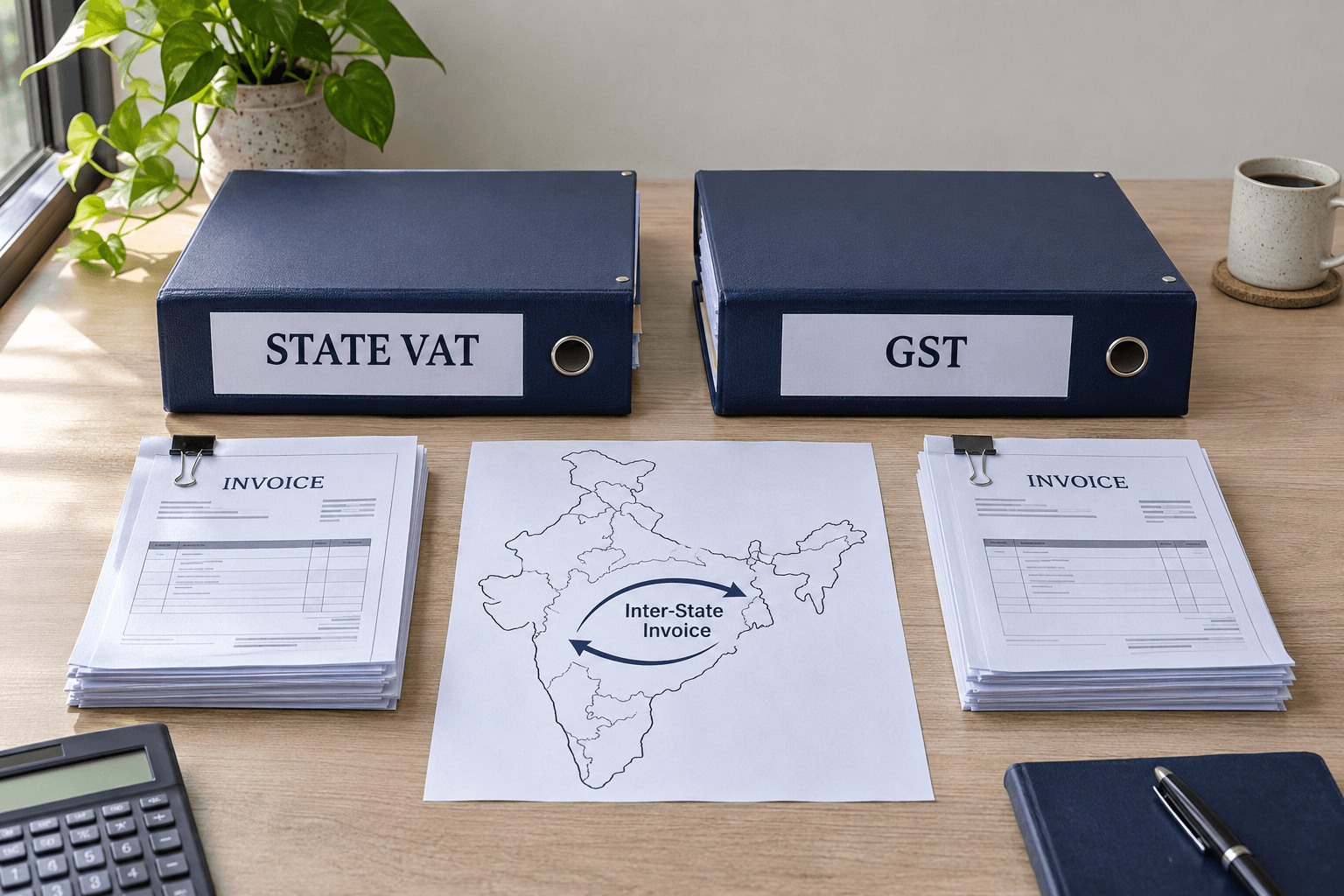
That credit stopped at three walls. Central excise and service tax could not be set off against State VAT. Inter-State sales attracted Central Sales Tax, collected by the selling State and not creditable to the buyer. And works contracts relied on the deemed-sale fiction in Article 366(29A) of the Constitution to be split before either government could tax its share.
What the 101st Amendment changed
The Constitution (One Hundred and First Amendment) Act, 2016 received the President’s assent on 8 September 2016, and its text is published in the Gazette of India notification of the 101st Amendment. It inserted Article 246A, which gives Parliament and every State Legislature concurrent power to make laws on goods and services tax, and Article 269A, under which the Centre levies GST on inter-State supplies and apportions it between the Centre and the States. It also narrowed Entry 54 of List II to the sale of six products. GST then came into force on 1 July 2017 through the CGST Act, the IGST Act and matching State and Union Territory GST Acts.
VAT vs GST: side-by-side comparison
| Point | State VAT (before 1 July 2017) | GST (from 1 July 2017) |
|---|---|---|
| Taxable event | Sale of goods within the State | Supply of goods or services or both |
| Who levies | Each State | Centre and States together (CGST plus SGST/UTGST); IGST on inter-State supplies |
| Constitutional basis | Entry 54, List II | Articles 246A and 269A |
| Services | Outside VAT; service tax levied by the Centre | Inside the same tax base |
| Inter-State trade | CST, origin-based, no credit to buyer | IGST, destination-based, creditable |
| Credit across taxes | No set-off between excise, service tax and VAT | Cross-utilisation under sections 49 and 49A of the CGST Act |
| Rates | Fixed by each State | Notified nationally on GST Council recommendation; two principal rates plus special and other specified rates |
| Registration threshold | Set by each State’s VAT Act | Generally ₹20 lakh aggregate-turnover threshold; ₹40 lakh for eligible goods-only suppliers in most States; ₹10 lakh in Manipur, Mizoram, Nagaland and Tripura, subject to notified exemptions and compulsory-registration provisions |
Taxable event: sale versus supply
Under VAT, liability turned on a “sale”, a transfer of property in goods for consideration. A stock transfer to a branch in another State was not a sale, so it stayed outside CST, usually supported by Form F.
GST taxes “supply”, defined in section 7 of the Central Goods and Services Tax Act, 2017. Supply covers sale, transfer, barter, exchange, licence, rental, lease and disposal, and Schedule I treats supplies between distinct persons, such as two GST registrations under one PAN, as supplies even without consideration. A branch transfer that was tax-neutral under VAT is therefore taxable under GST. Works contracts for immovable property are a supply of services under paragraph 6 of Schedule II.
Input tax credit: where VAT stopped and GST continues
Under VAT, a Chennai manufacturer buying steel from Maharashtra paid CST it could not recover, and service tax on its freight could not reduce its Tamil Nadu VAT. Both costs sat inside the price of its product. Under GST, the same purchase carries IGST the buyer uses against its own output tax, and GST on services feeds the same credit ledger.
Credit is still conditional. The principal requirements in section 16 include possession of a tax invoice or debit note, receipt of the goods or services, the supplier having furnished the invoice details and those details being communicated to the recipient, payment of the tax to the Government, and filing of the recipient’s return. The recipient must also pay the supplier the value of the supply plus tax within 180 days, subject to the prescribed rules and exceptions; otherwise, the credit is required to be reversed or paid back and may be re-availed on payment. Section 16(4) generally sets the time limit for taking credit as 30 November following the end of the relevant financial year or furnishing the annual return, whichever is earlier, subject to statutory exceptions. Section 17(5) blocks credit on specified items, including many motor vehicles and certain food and beverage expenses. The GST input tax credit conditions and blocked credits guide explains these restrictions further. For common input services received by one office for multiple distinct GST registrations, the ISD mechanism under section 20 has been mandatory from 1 April 2025; CBIC Circular No. 260/06/2026-GST dated 26 October 2026 provides further implementation clarifications.
Rates: State schedules versus one notified structure
VAT rates lived in each State’s schedules, so one product could carry different rates on either side of a border. GST rates are notified nationally on the GST Council’s recommendation. From 22 September 2025, India’s principal GST rates have been 5% and 18%, with a special 40% rate for specified goods and services; nil and other specially prescribed rates continue for particular supplies. Notification No. 9/2025-Central Tax (Rate) moved most goods to the 5% or 18% schedules, with 40% for a limited list, while separate schedules remain for items such as gold. The new 5%, 18% and 40% GST slabs explain the main rate changes. The GST Council’s 57th meeting on 8 October 2026 focused on further process reforms and selected clarifications; it did not replace this principal rate structure.
Where State VAT still applies
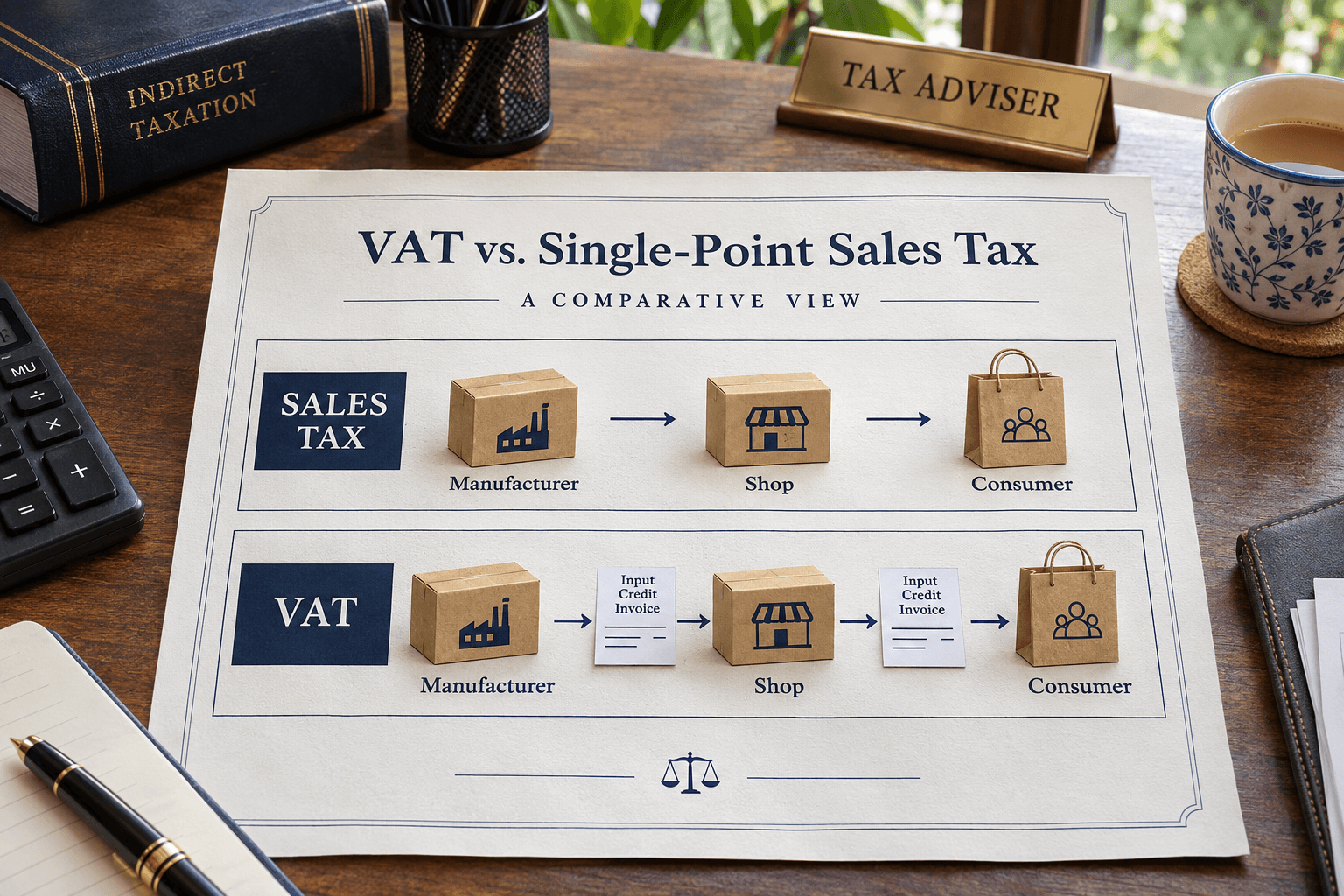
Article 366(12A) of the Constitution excludes the supply of alcoholic liquor for human consumption from GST altogether, and section 9(2) of the CGST Act defers GST on petroleum crude, high speed diesel, petrol, natural gas and aviation turbine fuel until a date the Government notifies on the GST Council’s recommendation. As at 19 November 2026, no such date has been notified, so these five petroleum products continue to be taxed under State VAT laws; liquor remains outside GST and is taxed under State laws. The CST Act also continues to govern inter-State sales of the six specified goods. The difference between VAT and sales tax, and where both still apply after GST, covers who is affected.
What the difference means in practice
Disputes for periods before 1 July 2017 are still decided under the State VAT Act and CST Act of the time, so old schedules, declaration forms and limitation rules remain live. Transitional credit under section 140 of the CGST Act has produced its own litigation. And a group with entities outside India faces a different comparison, set out in how India’s GST compares with VAT in the UK, EU, UAE and Singapore.
Conclusion
The difference between VAT and GST in India is not a change of name. VAT was a State tax on sales of goods, with credit trapped inside each State. GST is a concurrent tax on supplies of goods and services, with credit that crosses State lines. VAT still governs liquor, five petroleum products and every assessment for periods before 1 July 2017, so check which regime applies before you check the rate.
When a question turns on a specific section, rule or notification, AskSolique’s Research Center returns answers with citations to the source, so you can verify the provision yourself. See how AskSolique handles GST research.
Disclaimer: This article is for general information only and is not legal or tax advice. The law is stated as at the date of publication; check the current provisions and take professional advice before acting on it.
Frequently Asked Questions
Is GST better than VAT for businesses?
For many businesses, GST can reduce cascading compared with the earlier system because it allows eligible input tax credit across State boundaries and between goods and services. It is not automatically better in every case: credit restrictions, classification disputes, compliance costs and supplier-reporting conditions can increase the burden for particular businesses. GST also requires State-wise registration where applicable, invoice-level reporting and regular returns.
Can a business be registered under both VAT and GST?
Yes. A business can be subject to both regimes: it may need to comply with State VAT or sales-tax law for the excluded goods and with GST for its other taxable supplies. However, GST registration is not automatic merely because the business sells petrol, diesel, aviation turbine fuel, natural gas, crude oil or liquor. A person engaged exclusively in supplying goods or services that are not liable to GST or are wholly exempt is not liable to GST registration under section 23(1)(a) of the CGST Act. If the business also makes taxable GST supplies, registration must be tested against the applicable aggregate-turnover threshold and compulsory-registration provisions. Aggregate turnover includes exempt supplies, which include non-taxable supplies, so sales of excluded goods may still be relevant to that threshold. A fuel station selling lubricants or a hotel supplying taxable accommodation/food alongside liquor should therefore examine the GST registration test on its full facts.
Which taxes did GST replace in India?
At the central level, GST subsumed central excise duty to the extent of goods brought within the GST framework, service tax and the additional customs duties known as CVD and SAD. Central excise continues on specified products, including petroleum products and tobacco, under the applicable laws. At the State level, GST subsumed State VAT and sales taxes, entry tax, octroi, luxury tax, purchase tax, taxes on advertisements and entertainment tax other than that levied by local bodies. Central Sales Tax was not completely subsumed: it continues to apply to inter-State sales of the six goods that remain within the amended CST Act. Basic customs duty was not subsumed.
What happened to unused VAT credit when GST started?
Section 140 of the CGST Act and matching State GST provisions let registered dealers carry closing VAT credit into GST by filing Form GST TRAN-1, subject to conditions, including that the credit was admissible as input tax credit under GST. After disputes over portal failures, the Supreme Court in Union of India v. Filco Trade Centre (2022) directed that the filing window be reopened for two months.
Is VAT the same thing as GST outside India?
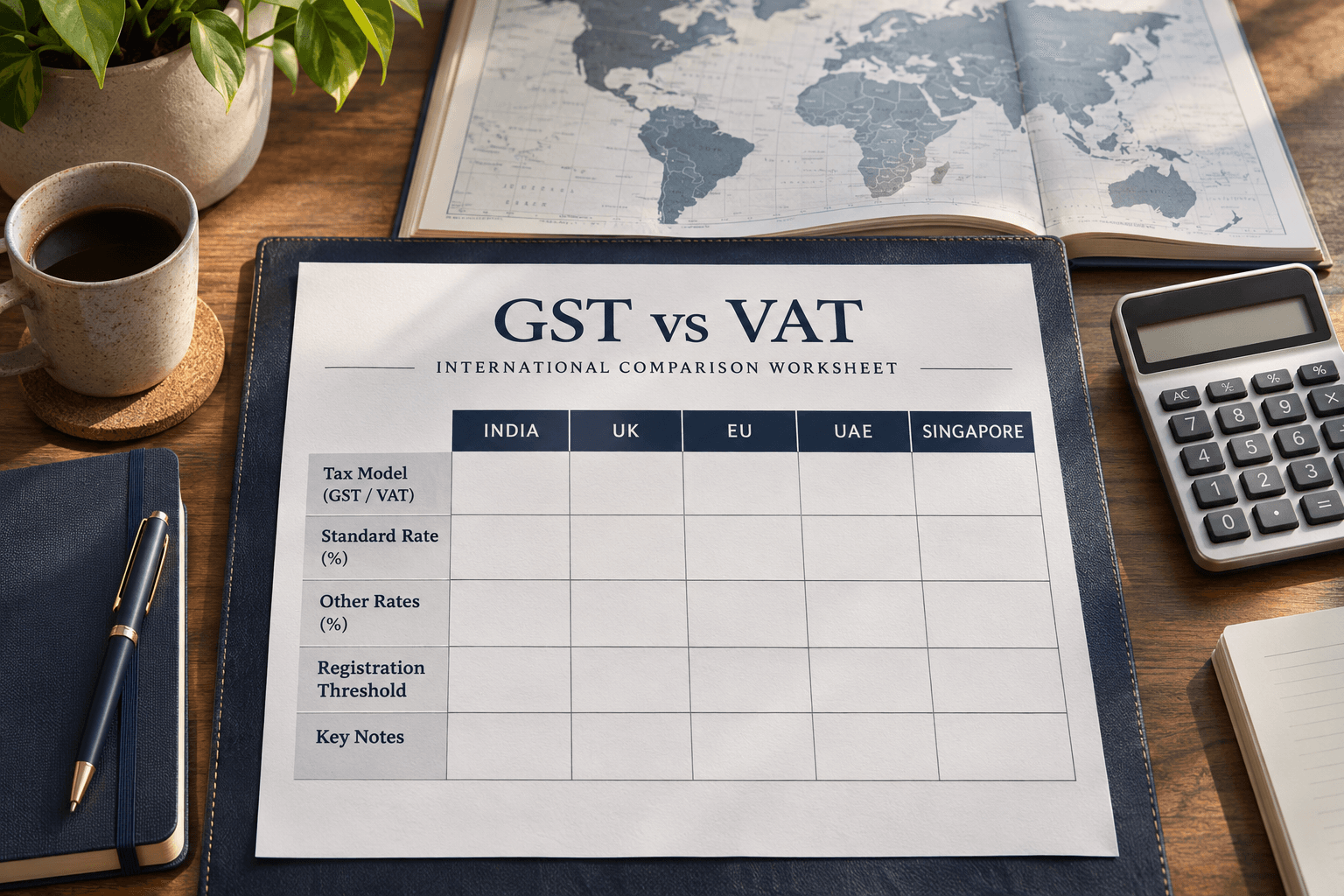
In design, largely yes. Both are multi-stage consumption taxes that let registered businesses recover tax paid on purchases, so the final consumer bears the burden. The name is a local choice: the UK, the EU and the UAE call theirs VAT, while Singapore, Australia and New Zealand call theirs GST. What differs between countries is the detail: rates, registration thresholds, exemptions, blocked credits, place-of-supply rules and the treatment of exports.
Stay in the know with AskSolique.
Occasional insights on tax, regulation, and what’s new at AskSolique. Only when we have something worth sharing.