GST vs VAT: How India’s GST Compares With VAT in the UK, EU, UAE and Singapore
Last updated:
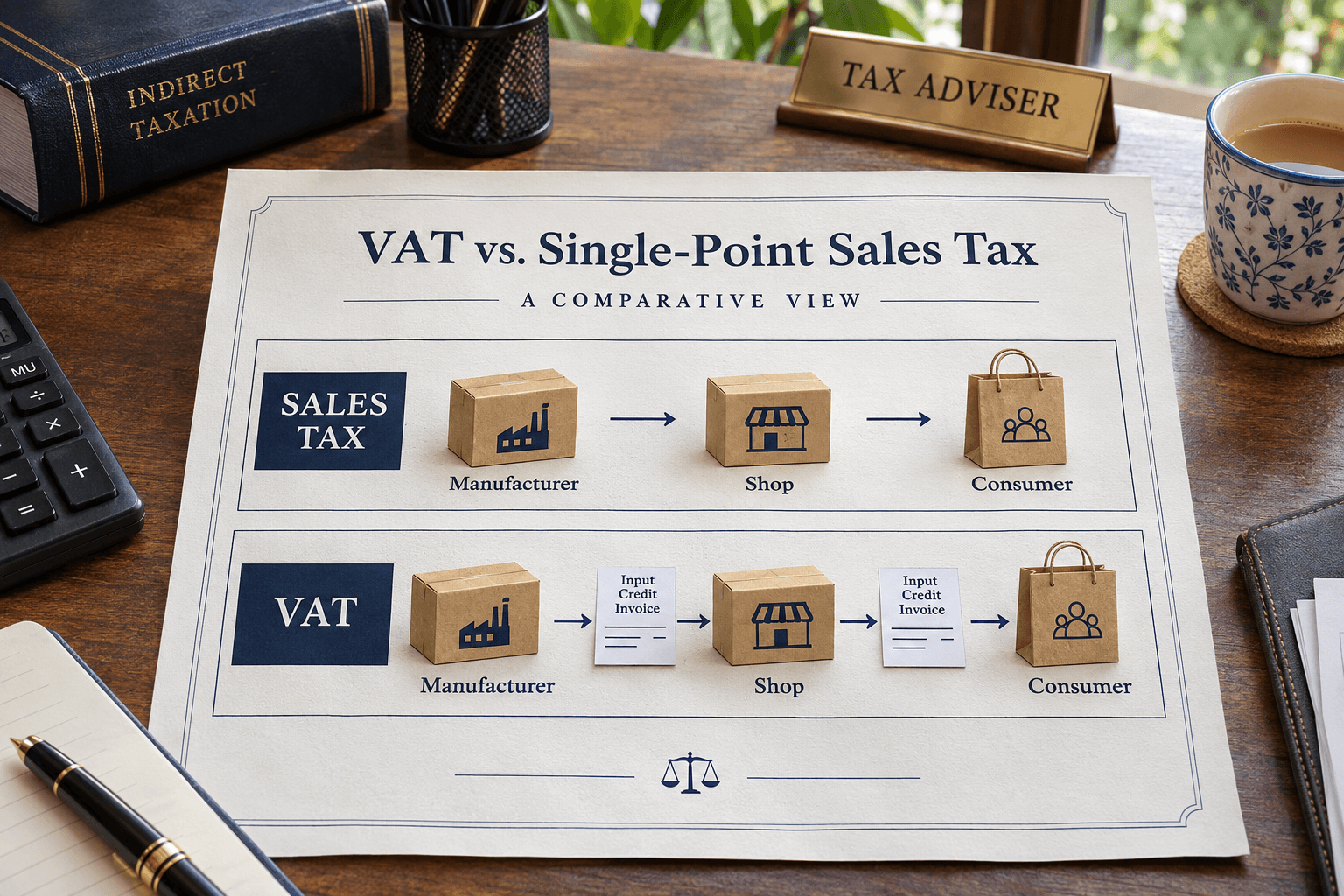
A group with an Indian subsidiary and a sister company in London, Dubai or Singapore soon finds the same transaction taxed under rules that look alike but behave differently. The GST vs VAT question is rarely about the label. India and Singapore call their tax GST, while the UK, EU and UAE call theirs VAT. All are broad forms of multi-stage consumption tax, but exemptions, blocked credits and place-of-supply rules mean that input tax is not recoverable on every purchase. The real differences lie in who levies the tax, the rates, when registration becomes mandatory, and how exports and imported services are treated. This comparison works through each using the governing law of each jurisdiction.
The short answer
GST and VAT are broadly the same type of tax: multi-stage consumption taxes under which registered businesses generally recover eligible tax paid on business purchases. The details differ, particularly for exempt supplies, blocked credits, cross-border services and registration. India’s version stands apart because two levels of government levy it, registration is generally State-wise, and inter-State trade runs through a separate integrated tax.
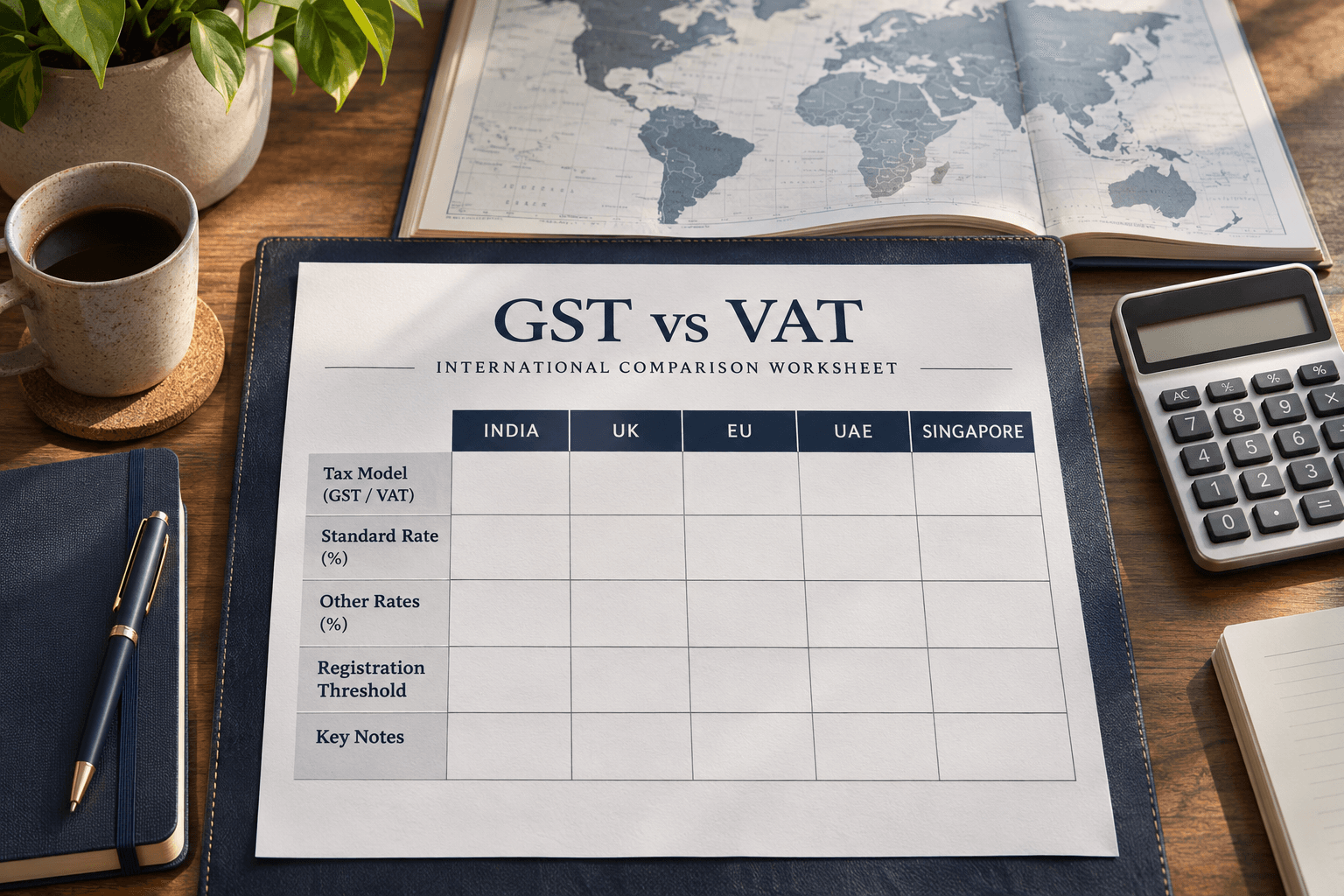
Side-by-side comparison
| Jurisdiction | Governing law | Who levies | Standard rate | Mandatory registration |
|---|---|---|---|---|
| India | CGST, IGST and State GST Acts, 2017 | Centre and States concurrently | 18% standard rate (5% principal reduced rate; 40% special rate; other specified rates also apply) | ₹20 lakh general threshold (₹40 lakh for eligible goods-only suppliers in most States; ₹10 lakh in Manipur, Mizoram, Nagaland and Tripura), subject to notified exemptions and compulsory-registration rules |
| United Kingdom | Value Added Tax Act 1994 | National government | 20% (5% reduced, 0% zero) | £90,000 taxable turnover; no threshold for a non-established supplier making taxable UK supplies where the customer is not liable under reverse charge |
| European Union | Directive 2006/112/EC, implemented nationally | Each member state | Set nationally, at least 15% | Domestic SME exemption threshold set by each Member State (maximum €85,000); separate cross-border SME scheme subject to a €100,000 EU-wide turnover ceiling and other conditions |
| UAE | Federal Decree-Law No. 8 of 2017 | Federal government | 5% | AED 375,000 for UAE-resident businesses; no threshold for a non-resident supplier where no UAE recipient is liable to account for the tax |
| Singapore | Goods and Services Tax Act 1993 | National government | 9% | S$1 million taxable turnover, tested retrospectively and prospectively under IRAS rules |
Dual GST versus a single national VAT
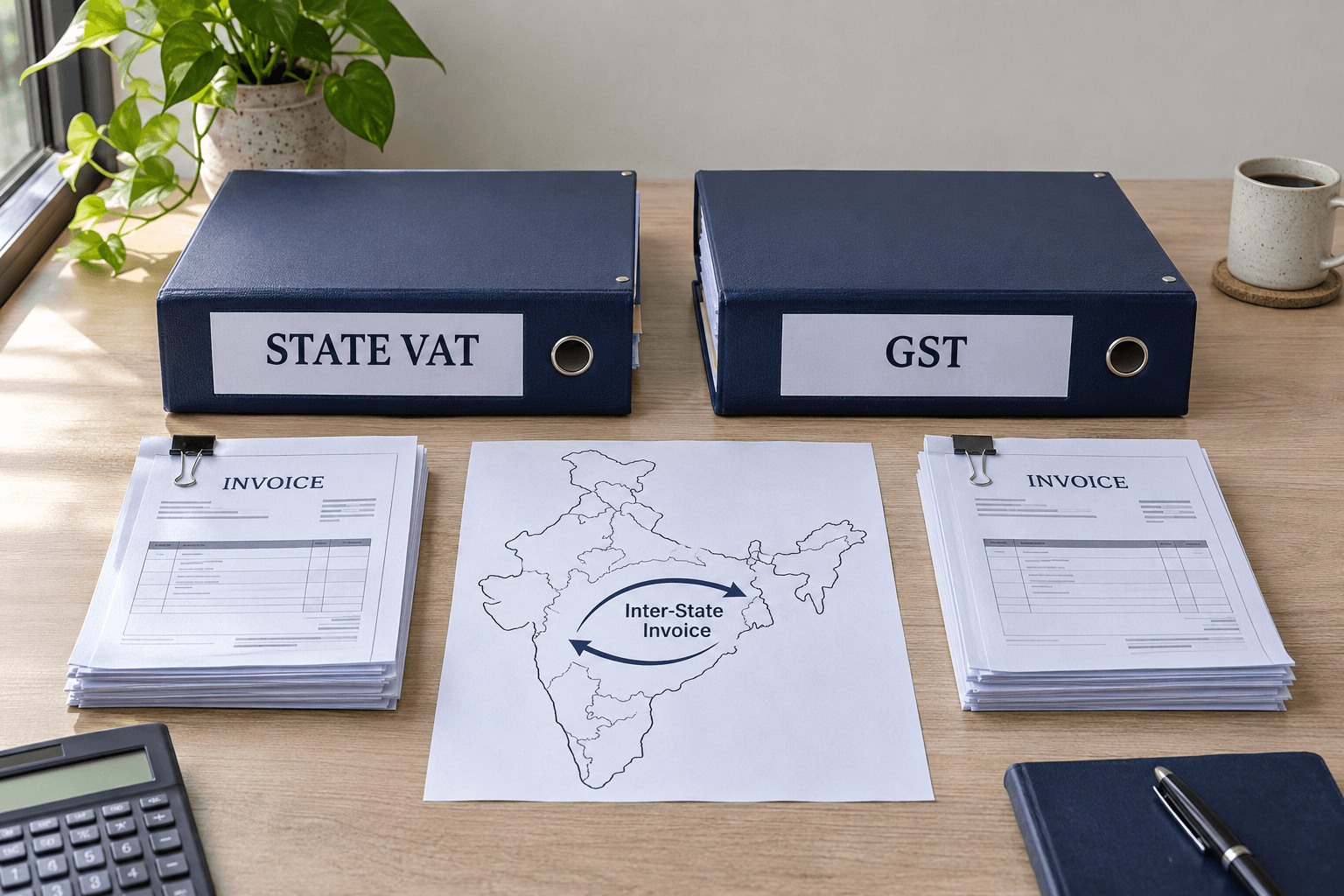
India is the outlier. Article 246A of the Constitution lets Parliament and each State Legislature levy GST, so an intra-State supply carries CGST and SGST side by side, and an inter-State supply carries IGST, which the Centre collects and apportions under Article 269A. The UK, the UAE and Singapore each levy one national tax. The EU harmonises VAT through a directive but leaves each member state to legislate and collect its own.
The effect shows up in registration. Indian registration is generally State-wise under section 25 of the CGST Act, and each registration of one PAN is a distinct person, so supplies between them can be taxable even without consideration. Where a business is liable to register in each of five States, it generally holds five GST registrations; a UK company with offices in England, Scotland and Wales ordinarily uses one UK VAT registration. Sellers trading into other States without an office must separately examine the applicable place-of-supply and registration rules, including notified exceptions for certain e-commerce suppliers; see Rule 14B GST registration for e-commerce sellers in another State.
Rates and rate structure
Since 22 September 2025, India’s principal GST rates have been 5% and 18%, with a special 40% rate for specified goods and services. Nil and other specially prescribed rates continue for particular supplies, so these are the main rates rather than an exhaustive list. The UK applies a 20% standard rate, a 5% reduced rate and zero rates for specified supplies, as set out on the UK government’s VAT rates page. The EU VAT Directive (Council Directive 2006/112/EC) requires a standard rate of at least 15% with no ceiling; Member States set their own rates and may apply reduced rates and, for specified categories, super-reduced or zero rates. The UAE applies 5% to most taxable supplies, and Singapore applies 9%, raised from 8% on 1 January 2024.
Headline rates can mislead: what a business actually bears depends on whether it can recover input tax.
Registration thresholds
Thresholds diverge sharply. India’s ₹40 lakh threshold for eligible goods-only suppliers comes from Notification No. 10/2019-Central Tax; the ₹10 lakh threshold applies in Manipur, Mizoram, Nagaland and Tripura. The general threshold is ₹20 lakh in most other States, subject to the nature of the supply, notified exemptions and compulsory-registration provisions. Section 24 of the CGST Act makes registration compulsory for specified categories, including certain inter-State suppliers, reverse-charge payers and non-resident taxable persons, but the relevant notifications and exceptions must also be checked.
The UK threshold is £90,000 of taxable turnover. A non-established business making taxable supplies in the UK generally has no registration threshold where the UK customer is not required to account for the VAT under the reverse-charge mechanism; the place-of-supply rules and the nature of the customer and supply therefore matter. The UAE requires a UAE-resident business to register once taxable supplies and imports exceed AED 375,000 over the previous 12 months or are expected to exceed that amount within the next 30 days, and offers voluntary registration from AED 187,500. A non-resident supplier must register from its first taxable UAE supply unless another person in the UAE is required to account for the VAT, for example under reverse charge. Singapore’s S$1 million threshold is tested retrospectively and prospectively under IRAS rules. Within the EU, domestic small-business exemption thresholds are set nationally and cannot exceed €85,000 under the SME scheme. A separate cross-border SME scheme is available, subject to conditions, where the business’s annual turnover across the EU does not exceed €100,000 and the relevant Member State has implemented the scheme. Businesses should check the UAE Federal Tax Authority’s VAT registration guidance and IRAS rules on when to register for GST for their specific circumstances.
Exports and imported services
The export treatment is not identical across the five systems. Each has rules intended to prevent domestic consumption tax from burdening qualifying exports, but the mechanism depends on the type of supply. India treats qualifying exports of goods and services as zero-rated supplies under section 16 of the IGST Act. The UK and EU generally zero-rate qualifying exports of goods when the prescribed conditions and evidence requirements are met, while many cross-border services are treated as outside the scope under place-of-supply rules rather than as zero-rated supplies. The UAE zero-rates qualifying exports of goods and services subject to statutory conditions. Singapore zero-rates exported goods and specified international services under section 21 of the GST Act. A supplier must therefore test the relevant jurisdiction’s export and place-of-supply rules rather than assume that every overseas customer transaction is zero-rated. In India, an exporter may supply under a bond or letter of undertaking without paying IGST and claim a refund of eligible unutilised credit, or, subject to notified conditions, pay IGST and claim a refund of that tax.
Imported business services are often taxed in the buyer’s country through reverse charge, but the scope and conditions differ. India applies recipient-side reverse charge to notified categories of imported services under section 5(3) of the IGST Act and the applicable notifications. The UK applies a reverse charge under section 8 of the VAT Act 1994 in relevant cases; the EU generally places liability on the business customer under Articles 44 and 196 of the VAT Directive; and the UAE applies Article 48 of its VAT law to imports of concerned services. From 1 January 2026, the UAE no longer requires a taxable person to issue a tax invoice to itself for imports accounted for under Article 48, although supporting records must still be retained. Singapore’s reverse-charge regime, in force since 1 January 2020, applies to businesses that are not entitled to full input tax claims. Foreign suppliers of digital services to Indian consumers must separately examine the OIDAR registration and tax rules; see the GST reverse charge mechanism checklist and how GST applies to cross-border OIDAR services for related India-focused guidance.
What this means for a cross-border group
For groups with an Indian entity, three points follow:
- The Indian entity stands alone. Each State registration is a separate taxable person, and cross-charges within the group are supplies.
- Export status must be proved, not assumed. Services rendered to an overseas parent are zero-rated only if every condition of “export of services” in section 2(6) of the IGST Act is met, including that the supplier and recipient are not merely establishments of the same person. A branch billing its foreign head office generally fails that test; a subsidiary billing its parent may qualify if the other statutory conditions, including recipient location and receipt of payment, are met.
- Entity choice changes the GST answer. Branch, liaison office or subsidiary: the choice affects registration and export treatment, as discussed in structuring inbound investment into India.
Conclusion
GST vs VAT is largely a difference of vocabulary at the level of the broad tax model, not a statement that the detailed rules are identical. Each jurisdiction taxes consumption through a multi-stage system, but exemptions, input-credit restrictions, place-of-supply rules and zero-rating conditions differ. India stands apart in its dual levy and State-wise registration, and its registration thresholds are much lower than those of the UK, the UAE and Singapore. For a group spanning these jurisdictions, the decisions that change tax cost include where to register, how to bill group entities, whether a service qualifies as an export and how cross-border input tax is recovered. A companion piece sets out the difference between VAT and GST within India.
In-house tax teams handling India alongside other VAT jurisdictions can use AskSolique for business to research GST questions against the Acts, rules and notifications that govern them. See how AskSolique handles GST research.
Disclaimer: This article is for general information only and is not legal or tax advice. The law is stated as at the date of publication; check the current provisions and take professional advice before acting on it.
Frequently Asked Questions
Does an Indian company need VAT registration in the UK or UAE to sell services there?
It depends on the type of service, the place-of-supply rules and who must account for VAT. For many business-to-business services, the UK and UAE apply a reverse-charge mechanism under which the local business customer accounts for VAT, so the Indian supplier may not need to register for that supply. This is not automatic for every service. Consumer supplies, digital services, services connected with local property or other specially treated services may produce a different result. In the UK, a non-established supplier making taxable UK supplies generally has no registration threshold where the customer is not required to account for the tax. The facts of each supply must be tested under the local law.
Does Dubai have GST or VAT?
Dubai has VAT, not GST. Dubai is one of the seven emirates of the UAE, and VAT applies across all of them under Federal Decree-Law No. 8 of 2017 at a standard rate of 5%, administered by the Federal Tax Authority. The UAE introduced VAT on 1 January 2018 under a framework agreed among Gulf Cooperation Council states, though not every GCC state has introduced VAT and rates differ among those that have.
Can a business recover Indian GST through its VAT registration abroad?
No. Indian GST cannot be credited through a UK or UAE VAT registration, and foreign VAT cannot be set off against Indian GST. Credit remains subject to the rules of the jurisdiction that charged it. Within India, however, common input-service credit received by one office for or on behalf of multiple distinct GST registrations is distributed through the mandatory Input Service Distributor (ISD) mechanism under sections 2(61) and 20 of the CGST Act. The mechanism became mandatory from 1 April 2025 and includes specified reverse-charge input-service invoices. CBIC Circular No. 260/06/2026-GST dated 26 October 2026 clarifies aspects of its implementation. This domestic distribution mechanism does not permit pooling of credits across countries.
Do Indian exporters need to file anything to export without paying IGST?
Yes. To export qualifying goods or services without paying IGST under the LUT route, a registered exporter furnishes a Letter of Undertaking in Form GST RFD-11 on the GST portal under rule 96A of the CGST Rules. An LUT is generally furnished for each financial year. An exporter may instead use the payment-of-IGST route where permitted by the applicable provisions and notifications. The eligibility and refund conditions should be checked for the particular export and the relevant tax period.
Is GST or VAT charged on imported goods?
Yes. All five jurisdictions impose import consumption tax on goods, although the collection and accounting mechanisms differ. India levies IGST on imported goods at the customs frontier under section 3(7) of the Customs Tariff Act, 1975, alongside basic customs duty. The importer may claim the IGST as input tax credit only if the statutory conditions are met and the goods are used for eligible business purposes. The UK charges import VAT; eligible VAT-registered businesses may account for it on their VAT return through postponed VAT accounting. The UAE and Singapore also tax imports, subject to their respective rules and reliefs.
Stay in the know with AskSolique.
Occasional insights on tax, regulation, and what’s new at AskSolique. Only when we have something worth sharing.