Difference Between VAT and Sales Tax: Where Both Still Apply in India After GST
Last updated:
Most explanations of the difference between VAT and sales tax are written for American online sellers, and they stop at the checkout counter. For an Indian business there is a second question: what remained outside GST, or has yet to be brought into its levy, after 1 July 2017? GST subsumed most State VAT and sales taxes, but alcoholic liquor for human consumption remains outside GST and the GST levy on five petroleum products is still deferred. State VAT or sales tax laws continue to apply to these products, while the Central Sales Tax Act, 1956 continues to govern their inter-State sales. This article explains the difference between VAT and sales tax, how each is collected, where the US model fits, and which Indian businesses still deal with both regimes alongside GST.
The short answer
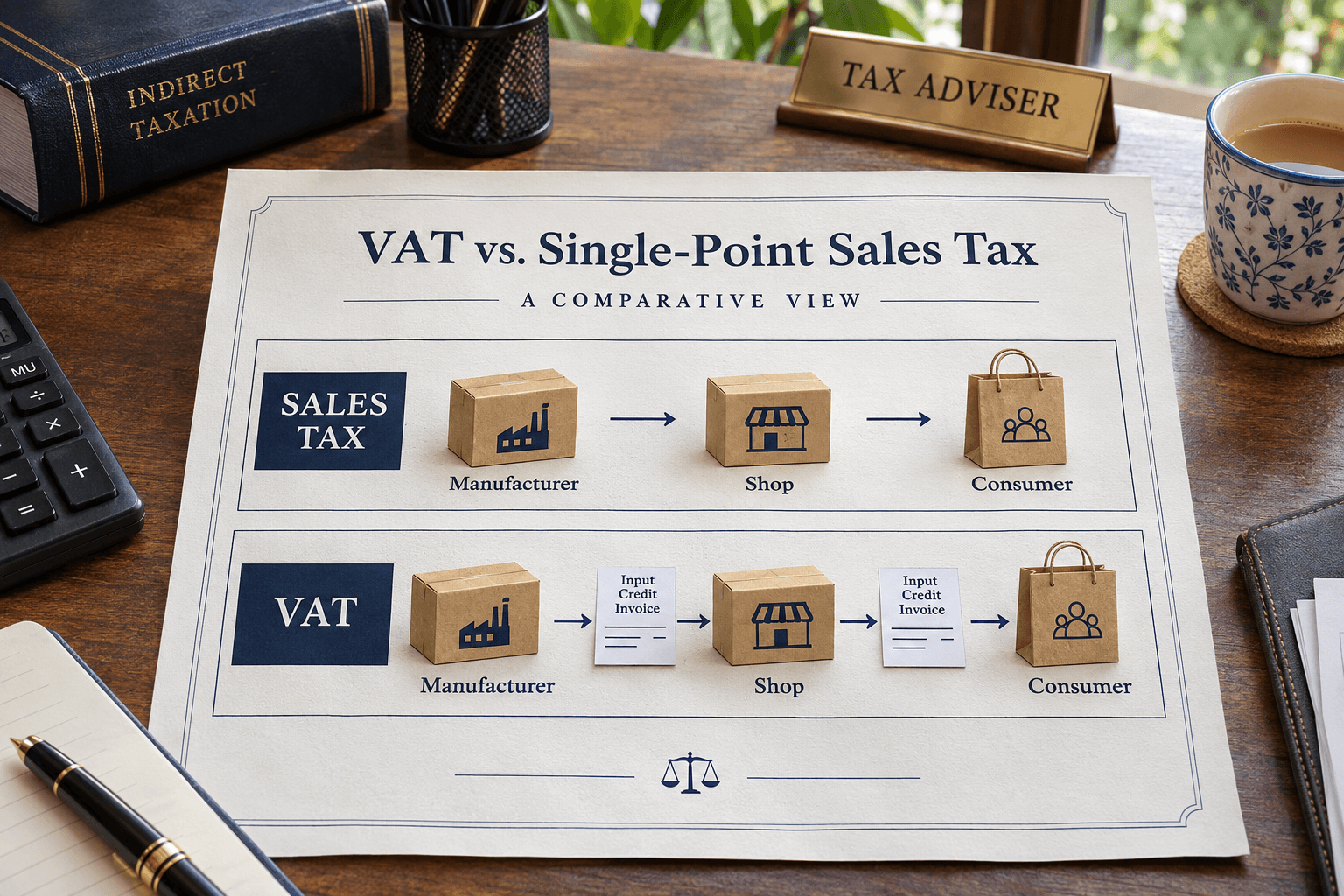
In the conventional US retail sales-tax model, tax is collected once on the retail sale to the final consumer. A VAT is collected at each stage of the supply chain, and each registered business generally deducts eligible tax paid on its purchases. The consumer generally bears the tax in both systems; the difference lies in the collection mechanism and the extent to which businesses can recover tax on their inputs. Actual sales-tax and VAT systems vary by jurisdiction and may contain exemptions or restrictions on recovery.
How a single-point sales tax works
In the conventional retail sales-tax model, tax is charged on the sale to the final buyer. Sales for resale are usually exempt against a resale certificate, so the tax is intended to fall once. That exemption does not cover every business input. Equipment and services bought by a business may carry sales tax that the business cannot recover, so the tax can enter the product’s cost and be taxed again at the final sale, an effect called cascading.
India ran its own version of this model for decades. Before VAT, each State levied sales tax under its own law, often at a single point of sale within the State, and inter-State sales were taxed separately under the Central Sales Tax Act.
How a multi-point VAT works
A VAT taxes each sale in the chain but lets every registered seller deduct the tax it paid on purchases. The example below uses an illustrative 10% rate.
| Stage | Sale price (₹) | Tax charged at 10% (₹) | Credit for tax paid on purchase (₹) | Net tax paid to Government (₹) |
|---|---|---|---|---|
| Manufacturer sells to wholesaler | 1,000 | 100 | 0 | 100 |
| Wholesaler sells to retailer | 1,500 | 150 | 100 | 50 |
| Retailer sells to consumer | 2,000 | 200 | 150 | 50 |
| Total | 200 |
Because each business generally needs a valid supplier invoice to claim credit, VAT can create a more continuous invoice-linked audit trail than a typical retail sales-tax model. Retail sales-tax jurisdictions also use invoices, returns, resale certificates and audits; the distinction is one of the structure and continuity of the trail, not the absence of controls under sales tax. This invoice chain was one reason for India’s move to State VAT in 2005 and then to GST in 2017.
VAT vs sales tax at a glance
| Point | Sales tax | VAT |
|---|---|---|
| Collection point | One sale, usually the final one | Every sale in the chain |
| Who remits | The seller at the taxed point | Every registered seller |
| Tax on business inputs | Often unrecoverable | Recoverable as input tax credit |
| Cascading | Likely where inputs are taxed | Largely avoided |
| Audit trail | Generally less continuous than a VAT invoice chain; resale certificates, returns and audits still provide controls | Invoice-linked at each stage, creating a more continuous transaction trail |
| Examples | US State and local retail sales taxes; India’s pre-GST State sales-tax laws | UK and EU VAT; India’s State VAT from 2005 (still applying to specified goods); GST, which is a form of VAT |
Where the US fits
The United States has no federal VAT; sales taxes are imposed by States and local governments. In South Dakota v. Wayfair, Inc. (2018), the US Supreme Court held that a State may require a remote seller with no physical presence to collect its sales tax where the seller meets the State’s economic-nexus rules. An Indian business selling goods online to US consumers may therefore have collection duties State by State, depending on the applicable sales or transaction thresholds and other local rules. An Indian GST registration does not discharge those US obligations.
Where VAT and sales tax still apply in India
The Constitution (One Hundred and First Amendment) Act, 2016 left two carve-outs from GST.
Liquor. Article 366(12A) of the Constitution defines goods and services tax to exclude the supply of alcoholic liquor for human consumption, and Entry 54 of List II, as amended, keeps taxes on its sale with the States. States tax it under their own VAT or sales tax laws, in addition to State excise duty. Bringing liquor into GST would need a further constitutional amendment.
Five petroleum products. Petroleum crude, high speed diesel, motor spirit (petrol), natural gas and aviation turbine fuel fall within the constitutional definition of GST, but Article 279A(5) leaves it to the GST Council to recommend the date from which GST will be levied on them, and section 9(2) of the CGST Act ties the levy to that notified date. As at 19 November 2026, no commencement date has been notified for the GST levy on these five products. States therefore continue to tax their sale under the applicable VAT or sales-tax laws. The Centre also levies central excise on specified petroleum products, but the applicable duty components and rates differ by product and are subject to the relevant tariff entries and notifications; they should not be treated as a uniform duty on all five products.
The Central Sales Tax Act, 1956 continues to apply to inter-State sales of these six goods. Section 2(d), as amended by the Taxation Laws (Amendment) Act, 2017, confines its definition of “goods” to petroleum crude, high speed diesel, petrol, natural gas, aviation turbine fuel and alcoholic liquor for human consumption. An inter-State sale of one of these goods remains within the CST regime rather than the IGST levy, subject to the charging provisions and any applicable exemption, concession and Form C conditions under the CST Act.
Who still deals with both regimes
Businesses handling these goods run two indirect tax systems at once:
- Fuel retailers and oil marketing companies sell petrol and diesel under State VAT, but lubricants and other goods under GST.
- Airlines buy ATF with State VAT and excise built into the price, which cannot be set off against the GST they charge on fares.
- Hotels, restaurants and bars account for liquor under State VAT and for food and rooms under GST.
- Manufacturers and transporters using diesel for generators or fleets bear VAT and excise on fuel as a cost.
The GST side carries its own consequences. Petrol, diesel and the other petroleum products on which the GST levy is deferred, as well as alcoholic liquor for human consumption, are not presently liable to GST. They fall within the definition of “exempt supply” for the relevant input-tax-credit provisions because that definition includes non-taxable supplies. Where a GST-registered business makes both taxable GST supplies and exempt or non-taxable supplies, credit attributable to exempt supplies is not available and common credit must be apportioned under section 17(2) of the CGST Act and Rules 42 and 43 of the CGST Rules. The GST input tax credit conditions and blocked credits guide explains the general restrictions in more detail.
Conclusion
The difference between VAT and sales tax comes down to the collection mechanism: a conventional retail sales tax is collected at the final sale, while VAT is collected in stages with credit for eligible tax already paid. In India, State VAT or sales tax continues to apply to liquor and five petroleum products, and the CST Act continues to cover inter-State sales of the six specified goods. Businesses that also make taxable GST supplies may need to comply with both regimes; GST input tax credit must be restricted or apportioned for exempt and non-taxable supplies under the applicable rules. For the wider picture, see the difference between VAT and GST in India and GST vs VAT across the UK, EU, UAE and Singapore.
CA firms advising fuel, aviation or hospitality clients can use AskSolique for CA firms to research GST provisions such as credit reversal under section 17(2), with citations to the Act and rules. See how AskSolique handles GST research.
Disclaimer: This article is for general information only and is not legal or tax advice. The law is stated as at the date of publication; check the current provisions and take professional advice before acting on it.
Frequently Asked Questions
Does the United States have VAT?
No. The United States has no federal VAT or national sales tax. Consumption taxes are levied by States and local governments as retail sales taxes and use taxes. A few States, including Delaware, Montana, New Hampshire and Oregon, have no statewide sales tax, and Alaska has none at State level but allows local governments to levy their own sales taxes.
What is the VAT rate on petrol in India?
There is no single rate. Each State fixes its own VAT or sales-tax treatment for petrol and diesel. Depending on the State, the levy may be a percentage, a fixed amount per litre or a combination, and rates can change by notification. The Centre separately levies central excise on petrol and diesel; the applicable central-duty components can change and should be checked against the latest Central Government notification and the Petroleum Planning & Analysis Cell’s published rate information.
Can businesses claim input tax credit on diesel used in their operations?
Not under GST. GST is not presently levied on diesel, so the VAT and central excise included in its price cannot be credited against GST output tax. Any credit under a State VAT Act is available only to the extent that Act allows, and it cannot be used against GST. For most transporters and manufacturers running generators, the tax on fuel is a business cost.
Is Form C still issued after GST?
Yes. Form C continues to be relevant for inter-State purchases of the six goods that remain within the Central Sales Tax Act: petroleum crude, high speed diesel, petrol, natural gas, aviation turbine fuel and alcoholic liquor for human consumption. A purchasing dealer may furnish Form C for goods specified in its CST registration certificate and intended for the permitted purposes in section 8(3)(b), such as resale, use in manufacture or processing of goods for sale, mining, telecommunications networks, or generation or distribution of electricity or other power, subject to section 8(4), the CST Rules and other statutory conditions. High Courts have considered the continued availability of Form C under the amended Act, but entitlement still turns on the statutory purpose and actual use. In Vedanta Ltd. v. Union of India (28 July 2025), the Bombay High Court at Goa refused Form C for diesel that the company had resold to third-party transporters, because its registration certificate permitted use only in its mining operations, and the Supreme Court upheld that decision in March 2026. In a connected petition by Sesa Mining Corporation, the same Court held that CST registrations do not lapse merely because GST was introduced, and directed the authorities to reconsider the request for C-Forms. A buyer should therefore check the exact goods and permitted use recorded in its certificate and the current case law before claiming the concession.
Why is VAT called a consumption tax if businesses pay it?
VAT is designed as a tax on consumption. A registered business charges VAT on its taxable sales and generally recovers eligible VAT on purchases, remitting the difference. The final consumer usually bears the tax because the consumer cannot claim input tax credit. Where a business makes exempt supplies or is otherwise unable to recover input tax, some VAT can remain a business cost.
Stay in the know with AskSolique.
Occasional insights on tax, regulation, and what’s new at AskSolique. Only when we have something worth sharing.